New RAH worker wants compo after own “grossly negligent” act
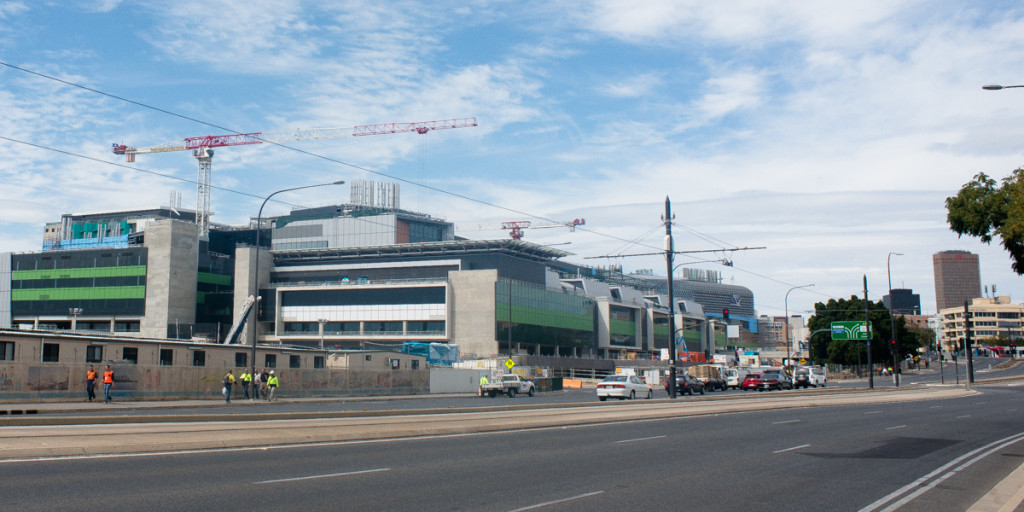
A construction worker, whose “grossly negligent” misconduct could have cost a co-worker his life, has won the right to claim for compensation over the incident.
Matthew Hourigan was supervising a crane movement on the eighth floor of the new Royal Adelaide Hospital, under construction last year, when he gave the “all clear” for the crane to move. However, he had failed to look backwards to notice that another worker, Owen Fasavalu, was caught by a rope attached to the crane.
Fasavalu, “a heavy man of at least 140 kilograms”, was caught in the rope and raised by his arm several metres into the air, Senior Judge WD Jennings said in a Workers Compensation Tribunal judgement delivered last month.
Fortunately, Fasavalu walked away with little more than a sore hand, the judgement says.
Hourigan, however, later claimed workers’ compensation for post-traumatic stress disorder, which he said was induced by the incident.
He gave evidence that he had been terrified the rope would break, and that Fasavalu would fall to his death.
He said that, after the incident, he was unable to work and had been prescribed antidepressants.
The compensation claim was initially rejected by a third party claims administrator last year.
You might like

The administrator, Gallacher Bassett, rejected the claim on the basis that any psychological injury suffered by Hourigan was related to concern that he would be disciplined or fired because of the incident, not from the trauma of the incident itself.
Jennings, however, overturned the finding.
He ruled that Hourigan “committed a grave error that could have cost a workmate his life”, but he had not done so intentionally.
“Whilst his conduct might be rightly described as grossly negligent, it was not wilful,” Jennings said in his judgement.
“…the evidence clearly establishes that the worker gave the crane driver the all clear without first checking that Mr Fasavalu was safe.
“There is no doubt that the worker’s conduct in so doing was gravely wrong.”
However, Jennings said, “the evidence does not persuade me that the worker, when acting as he did, did so in the knowledge of or with reckless indifference to the consequences of his actions”.
“Having heard and observed his (Hourigan’s) evidence I formed a favourable view of his credibility,” Jennings said.
“… there is no evidence of any prior issues regarding the workers work as a dog man (crane supervisor).”
The Senior Judge accepted that Hourigan felt responsibility for the people he worked with, and that it “would be surprising for him to suffer the psychiatric injury that is the subject of this dispute” if he had been “indifferent” to that responsibility.
Stay informed, daily
According to Jennings’ summary of Hourigan’s evidence, the 6mm rope “bit” into Fasavalu’s hand because it was so thin, and should have been 16mm rope.
Hourigan stated he had repeatedly asked for 16mm rope before the incident, but was told “we’ve got nothing”.
He also criticised the safety culture on the new Royal Adelaide Hospital construction site, saying there were “potential fatalities occurring on a daily basis” at the site.
Despite acknowledging there was a safety meeting at the site each morning, and that the employer, Hansen & Yunken, supplied extensive safety literature to workers, he said that the culture at the site involved “just getting things done despite any safety risks”.
In a statement to InDaily, Hansen Yunken – Leighton Construction Joint Venture (HYLC) said it has “one of the most stringent safety standards in South Australia with a number of initiatives that have been adopted across the project”.
“We continually review our safety procedures and adopt new and safer ways of working to minimise any risk to our workforce.
“HYLC Joint Venture are unable to comment on the specific details of the (incident) however we can confirm that safety has and will always remain a high priority for the project.”
New hospital construction “plagued by safety issues”
Industrial officer with the Construction, Forestry, Mining and Energy Union (CFMEU) Liz Dooley told InDaily the construction of the hospital had been “plagued by safety issues” including the death of worker Jorge Castillo-Riffo last year.
“The facts speak for themselves,” said Dooley.
“There have been numerous safety issues on the site that have been reported in the news in the course of the construction of the project.
“The union’s advocated for members on safety issues throughout the entire construction of the nRAH and we will continue to do so.”
Dooley would not be drawn on Hourigan’s claims that “the culture at the site was one of just getting things done despite any safety risks”.
However, she said that “if workers genuinely feel that there is an imminent threat to their health and safety, we fully support their right to stop work and remove themselves from danger”.
“… doing that is not industrial action. That’s taking care of their own health and safety.”

Want to see more stories from InDailySA in your Google search results?
- Click here to set InDailySA as a preferred source.
- Tick the box next to "InDailySA". That's it.