Hills fire: Ecological damage being assessed
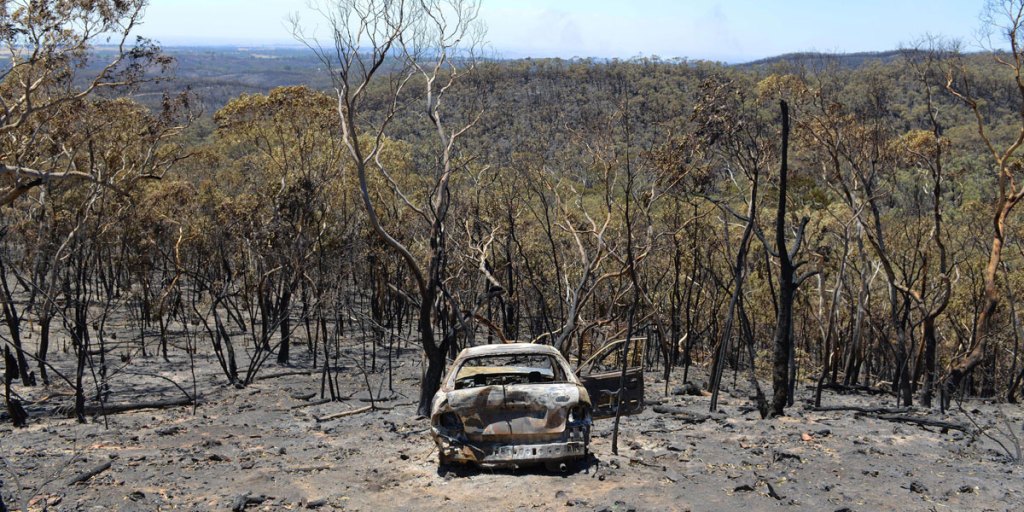
A team of scientists is this morning preparing to head to the fire ground and assess what 12,500 ha of scorched earth means for the Adelaide Hills ecosystem.
South Australian biodiversity, soil, water and forestry specialists and a team of experts from Victoria will travel to the worst-affected bushland and deliver recommendations to the government on how to minimise environmental damage from the blaze.
“What we want is some quick information to help guide what are the priorities to help deal with, and minimise any negative impact,” said Senior Fire Ecologist at the Department of Environment, Water and Natural Resources, Mike Wouters.
“The urgent issue for us at the moment is erosion and water quality, water catchment issues, because there is potential rain in the next few days.
“(Other) things we’re looking at are soil erosion, impact on water catchment and flora and fauna.”
The teams have been using satellite imagery technology to find out where the fire has burnt the hottest, and where the ecosystem needs the most help to recover.
READ MORE: Bushfire claims already top $13 million
Wouters said that while bushfires are a natural process in the South Australian and broader Australian ecosystems, some plant and wildlife species will struggle to regenerate.
You might like


“The bushland areas themselves will cope with fire (but) there are some fire-sensitive communities … particularly, say, wet gullies, or other places that don’t burn very often.
“If they have been burnt then they may be set back. Some species might shift; some might disappear from some local areas.”
He said extinctions of animal and plant species were a possibility, but that several methods would be available to conservation teams to help minimise them.
“That is possible, and its certainly one of the things that we’ll be looking at.
“(However) we can reintroduce some of them if we’ve got seed or material from elsewhere.
“At a worst case scenario, Botanic Gardens people will come in and try and collect seed or collect specimens … to try and at least have them in a breeding program.
“If a lot of large trees with hollows disappear, there might be issues around nesting for particular species, as well as soil and water type issues.
“Fire is not foreign (to the region) but, because of our human activities and interventions over the last 150-odd years, some of them aren’t quite as able to recover as well as they used to.
“We’ve changed the water regimes in some areas, we’ve cleared areas … so those sort of activities will inhibit some of the recovery.”
However, he said that when the final embers stop smoldering in the Adelaide Hills and the first heavy rains fall, a natural process will already have begun to regenerate the land.
Stay informed, daily
“The next significant rainfall will be what triggers the regeneration events,” he said.
“The area will look devastated until then.
“By next spring the site will look somewhat green again, and there’ll be a number of species that are quite spectacular in their flowering (which) are stimulated by the fire.”
He said the burnt-out area will likely be a short-term haven for introduced weak species, but it’s not all bad news.
“Blackberry will aggressively spread after the fire, because most (introduced weed species) have either seed or sprouting mechanisms.
“One of the issues will be to look at those and try and minimise the spread.
“It’s a bit perverse, but something like blackberries provide shelter for bandicoots. So in some ways, they can be a benefit in the short term.
“They give somewhere for particularly the small mammals and the small birds to hide in.
“But in the long term, obviously that’s not desirable.
“The fire will also provide some opportunity to get in to some of the more hard to get to infestations.”
Meanwhile, hundreds of firefighters are facing extreme conditions as they attempt to contain the fire which is still burning out of control.
The bushfire, now burning into its sixth day, has already destroyed or badly damaged 38 homes, and burnt more than 12,000 hectares.
The Country Fire Service has become more confident in recent days that it will be able to contain the blaze, and crews were buoyed by news of easing conditions and the possibility of rain.
But more than 500 firefighters, including reinforcements from interstate, will first need to face extreme heat as the temperature soars to 38 degrees for a second day in a row and shifting winds presenting dangerous conditions.
The latest warnings and incidents are on the CFS website (click here) or the CFS Facebook page (click here), and on 891 ABC Radio.
– with AAP
Want to see more stories from InDailySA in your Google search results?
- Click here to set InDailySA as a preferred source.
- Tick the box next to "InDailySA". That's it.