Mining elders fight back on “scare” campaigns
A powerful group of mostly retired or semi-retired oil and gas industry figures has emerged to counter “scare campaigns” about their industry, including claims that “fracking” is damaging to the environment.
The group – calling themselves The Norwood Resource (TNR) – has ambitions to expand around the country and now has branches in Western Australia and South Australia.
One of its central aims is to dissect and destroy arguments made by conservation groups and others that hydraulic fracturing and related processes harm animal species and risk contaminating the water table.
Around 100 people – mostly men over the age of 40 and a handful of women – packed into the Republic Hotel on Friday for the group’s first South Australian meeting on Friday.
Former managing directors of ASX-listed oil and gas companies, former resource exploration directors and academics were all in attendance – as was state Liberal MP Vincent Tarzia.
TNR Public Officer John Hughes described the new organisation as “a group formed to assemble and disseminate the facts, counter the misinformation, inform the media (and) establish and maintain a centre of expertise”.
“And it’s all going to be based on science, facts and observational data,” he said.
You might like

“Our inspiration was the words of former Labor federal Resources Minister, Gary Gray, who wanted to put the evidence and science into the current debate (and) balance the misinformation that was being pedaled.”
Over the next few months, the group plans to establish internal “Category Interest Groups” to publish pro-industry articles on subjects such as fracking, climate change and seismic surveying.
It also hopes to team up with oil and gas lobby, the Energy Resource Information Centre, and like-minded community groups to push its message.
TNR grew out of an informal monthly meeting of about 20 current and former oil and gas employees, who became increasingly worried about public perceptions of their industry over about 18 months.
“Over time, the increased poor reports about the impact of oil and gas on the environment, which was being misrepresented in the press, really dismayed a lot of people that went to these meetings,” said TNR secretary Bruce Holland.
“There’s lots of scary claims and lots of scary stories, a lot off which are baseless.”
Hydraulic fracturing is a process for extracting resources from hundreds of metres within the ground by which rock is drilled into and fractured by small, targeted explosives – water, chemicals and crush-resistant sand of specific particle size are injected into the fracture.
Pressure is later released to force oil or coal seam gas up through the drill pipe.
Stay informed, daily
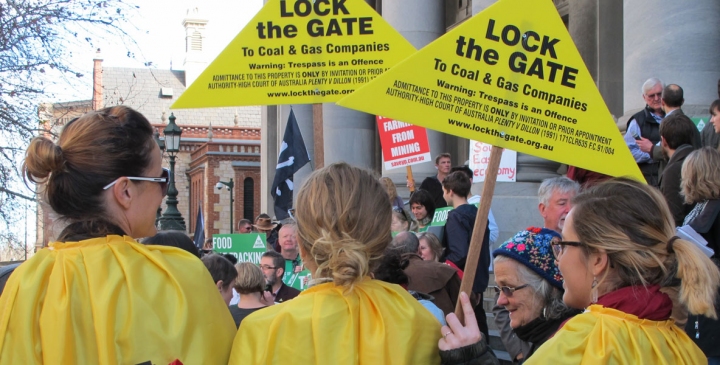
Anti-fracking activists such as Lock the Gate – which urges farmers to refuse miners’ requests to enter their properties – are concerned that groundwater could be contaminated, and that billions of litres could be wasted during the process.
In South Australia, TNR has been most dismayed by an “almost hysterical campaign” by conservation groups to prevent seismic surveys in the Great Australian Bight.
The mining industry has also been dismayed by a state Liberal-backed moved to establish a parliamentary inquiry into fracking in the South-East. Several companies are exploring the possibility of unconventional gas extraction in the agricultural area – a move which has been opposed by local Liberal MPs.
“There is no reported evidence that any fracking in Australia has had any impact on water sources,” Holland said.
He said he was not aware of any peer reviewed literature which had demonstrated a deleterious impact on the environment from fracking, and blamed clever marketing by green groups and “cowboy” oil and gas companies in the United States for tarring the industry’s name.
“I think it’s come from the States – the States in some areas have had poor regulatory oversight and also in the US, some of the oil companies have been almost cowboys, and there was a push coming out of the States for more environmental oversight, which was jumped on by the likes of Greenpeace,” he said
“Some of the environmental groups seem to want to make issues out of areas that are not issues.”
This afternoon, National Coordinator of Lock the Gate Phil Laird told InDaily farmers like him have plenty to be concerned about with relation to fracking and coal seam gas.
“I’m a landholder; I’ve got concerns. All the people in my district have concerns,” he said.
“The fact that the list of chemicals that are used in the process is unavailable (and) the fact that the companies regularly use confidenctiality agreements to ensure that landholders can’t talk to each other and can’t compare notes (are concerning).
“Sooner or later reality has to hit and there are places where these industries just can’t go.”
Laird cited concerns raised by the Chief Scientist of the United Kingdom, Mark Walport, that fracking held risks similar to those posed by thalidomide, tobacco and asbestos, a report by the Chief Scientist of New South Wales and a Southern Cross University study as evidence that farmers’ concerns are backed by science.
Want to see more stories from InDailySA in your Google search results?
- Click here to set InDailySA as a preferred source.
- Tick the box next to "InDailySA". That's it.