Quiet voices: The slow contraction of playwriting in South Australia
Emerging South Australian playwrights are feeling the pressure to make their work smaller, shorter and – sometimes – more thematically conservative.
Last Friday evening, about 15 people sat down in a little cinema in Prospect to watch Prima Facie – a play performed on a West End stage in London and beamed around the world through the UK National Theatre’s screen program.
The play’s writer is Suzie Miller, an Australian now based in the UK. But, judging by the pre-show chatter, the Adelaide audience was there to see the production’s star – Jodie Comer, of Killing Eve fame.
Miller is a playwright of prodigious talent. Her work has been acknowledged with countless awards. Even so, says Tony- and Olivier-awarded UK artistic producer Richard Jordan, it can still take a special and rare set of circumstances for Australian writing to get a foothold in the West End.
“It’s interesting that it’s a solo play,” says Jordan, “which perhaps says a lot about coming back post-COVID and about risk and cost and taking chances on new plays.
“A one-person show is going to be considerably cheaper… [and] it’s got a big star so it makes it a perfect commercial play in that particular sense.”
Jordan, who has worked in theatre around the world for more than 30 years, including extensively in Australia, noticed a distinct shift in the model for commissioning new work in the 1990s and 2000s.
“The interesting thing to consider about writers like, for example, [Harold] Pinter, is if he was a writer today and his play was presented – let’s say it was The Caretaker – we’d probably say, ‘Pretty interesting voice, put it on in a small studio theatre of about 120 seats’,” says Jordan.
“There was a time once when a show might have opened in a bigger theatre, been successful and had that international recognition, and there would have been subsidiary productions. It changed when many large repertory theatres – once a creative staple in regional towns and cities – began to close.”

The opportunities for new stage work to find exposure are dwindling around the world. And for emerging playwrights and theatre-makers in Adelaide – those operating on the other end of the spectrum from writers like Miller and Pinter – things are particularly grim.
In his regular travel to Adelaide, Jordan has noted a gap in the stage ecology.
The small city, through events like the Fringe, offers plenty of platforms for independent makers to present self- or partially-funded works, and there is a handful of healthy main-stage commissions (Windmill Theatre Company, State Theatre Company SA, and the Adelaide Festival regularly commission new SA writing). However, there are fewer in-between opportunities and second-tier companies to help playwrights bridge the gap between DIY and professional.
“Progression is really the most important thing with playwriting – how you take those incremental steps, and the progression has to be a logical and clear stepping stone-process,” says Jordan.

You might like


For emerging Adelaide playwright Anthony Nocera, the lack of a clear pathway has sometimes translated into confusion.
He says that trying to get your script produced “feels very opaque”. “What do you do and how do you do it? There’s no development opportunities for playwrights that are paid, or any training in South Australia.”
There are local organisations – among them RUMPUS, SA Playwrights Theatre (SAPT), Theatre Republic, Brink Productions and venues like Holden Street Theatres and Goodwood Theatre – dedicating precious resources to helping writers get their new work off the ground. But they face an uphill battle. Funding is an ever-green problem in the arts, and playwrights are particularly stymied by the drawn-out (SAPT creative producer Lucy Combe, also a playwright, says a good play can “take as long as a novel” to write) and resource-heavy drafting phase.
“Playwriting is incredibly specialised and it’s not as if you can read it on a page and 100 per cent understand what it’s going to be like embodying it with actors,” says Nocera, who stresses how fortunate he is to be developing his script, Log Boy, with Theatre Republic after initial support from Carclew.
“Seeing it on the floor and feeling it move is really, really important. When funding is tied to production outcomes it means that the development of new work really suffers.”
Equally frustrating is a lack of physical space. SAPT, which is funded on a project-to-project basis, has a partnership with in. café + studio in Pirie Street that enables it to present regular staged readings of new writing.
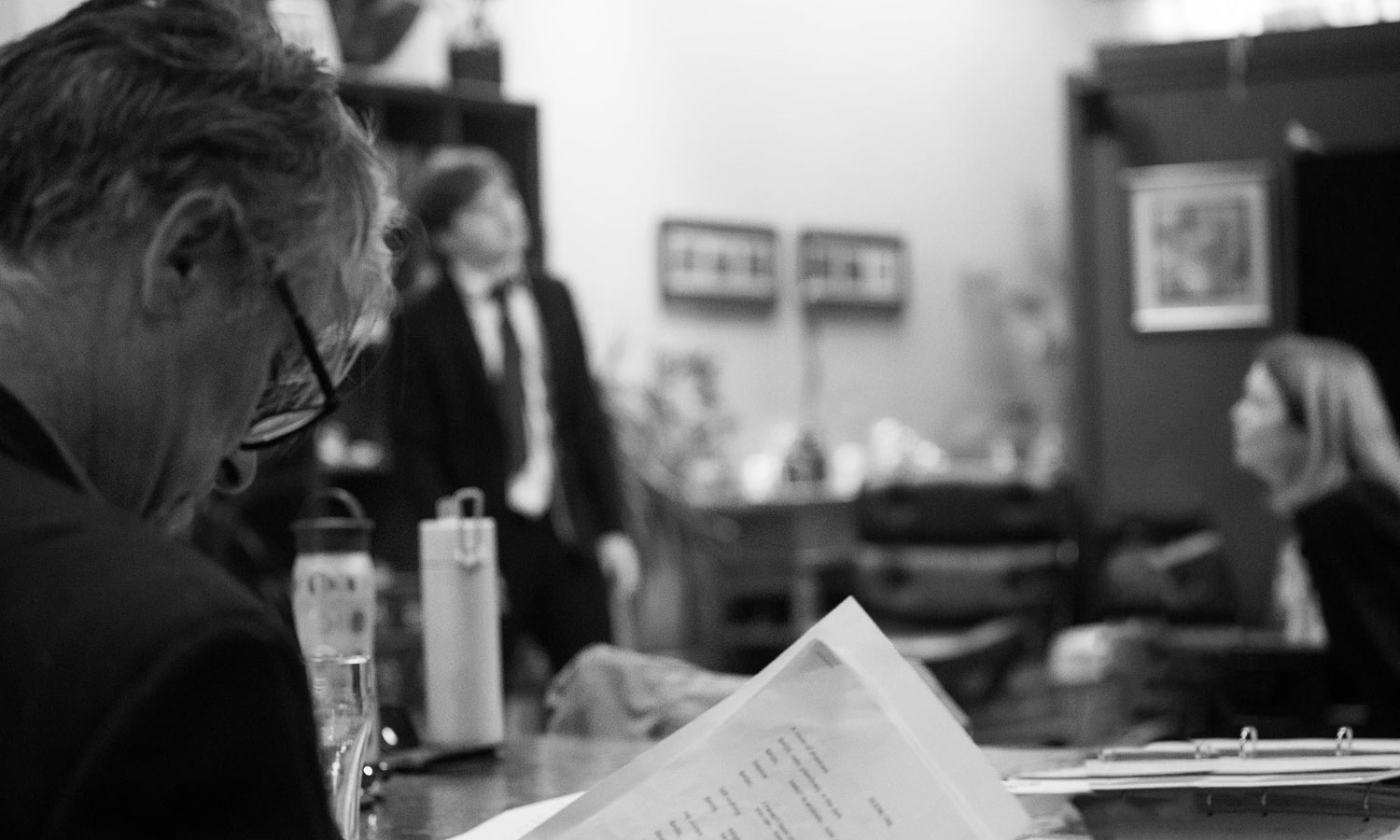
For undertakings that require a bigger footprint, the playwrights are often forced to find ad hoc venue solutions. Combe spoke with InReview just before the first full-cast reading for the new season of The Deep North, which SAPT held in a cast member’s lounge room.
“When everyone’s on the smell of an oily rag, then you know what venue costs are like,” Combe says. “And having a space to develop confidence, having space to fail, having a safe space to be able to try out an idea and see if it works and accept if it didn’t [is really important].
“I think that is one really sort of a tangible thing that the Government could actually help us with.”
A spokesperson for Arts SA told InReview it had been “focussed on getting the best out of existing venues”. They said initiatives included financially supported reduced-cost-access to the Adelaide Festival Centre’s Space Theatre for presentations by independent artists and small-to-medium companies, capital upgrades to the Queens Theatre to improve its usability, and support for smaller venues such as Nexus Arts and Holden Street Theatres.
Arts SA’s Arts and Culture Grants Program supports the creative development of theatre works through a number of grant categories, the spokesperson said, with a total of $347,699 recommended for theatre creative developments in the 2021-22 financial year and a further $319,500 recommended “for theatre projects with a creative development component”. Venue hire is an eligible expense for creative development and/or presentation in grant applications.
" Some of the feedback I’ve had is, ‘Make it a one-person show and take it to Sydney’ "
Less prosaic than the issue of venue costs, but perhaps even more weighty, is the challenge of cultural restraints playwrights and theatre-makers feel.
Nocera and Combe both noted a sense that some stories might be perceived as too risky for Adelaide.
“One of the problems can still stem from a little bit of cultural cringe,” says Combe. “A sort of fear about what you’re allowed to say, what you’re going to get an audience for, what your peers are going to say.
“I think there is a sense of what you’re allowed to write about and what you’re not.”
The combination of factors has a chilling effect on creativity. Nocera says he’s consistently grappled with his script, trying to make changes in line with practical realities but without compromising narrative and creative integrity.
“Some of the feedback I’ve had is, ‘Make it a one-person show and take it to Sydney’,” he says. “My response to that was, ‘Well, it’s not a one-person show, it’s a play for five people, and I wrote it here.
“I have been thinking, ‘How can I… make edits to the play that make it leaner and make it more producible? But they aren’t compromises purely to get the show on, they also make the work better and make it a more enjoyable and more artistically sound work.”

Combe says the pressures can coalesce.
“I think there’s definite burnout that people experience,” she says. “I’ve heard so many stories from independent artists that don’t get funding to do their show and they’re so exhausted through that.
Subscribe for updates
“It’s very difficult for people to be able to sustain a full-time artistic career – almost impossible.”
Resultantly, some people leave the industry, while others recalibrate their vision to be a little less ambitious.
New voices are lost and new plays become rarer and smaller in scale. And, the problem is cyclical. As emerging theatre-makers are confined to even smaller stages and given fewer opportunities, the skills gap between them and the main stage yawns even wider.
There are, of course, solutions. Beyond more funding and more venue space available at accessible prices, SA organisations have been thinking laterally.
SAPT is dedicated to making work that speaks outside what has traditionally been perceived as the theatre bubble. It invites in different audiences through a development process and presentation model that is in dialogue with communities.
“We’re really interested in getting new voices out and different styles of theatre and writing as well, rather than the sort of same Euro-centric model of playwriting or production making,” says Combe.
“It is important to think beyond the black box – excuse the pun. I think finding ways to keep theatre relevant is ongoing.”
The potential of SAPT’s approach is evidenced by the success of The Deep North, which the organisation premiered at multi-disciplinary venue The Lab during Adelaide Fringe in 2021. The coming-of-age musical was made in collaboration with African-Australian artists and has been picked up for a secondary season that includes dates at the Space Theatre and a regional tour.

Fostering more secondary seasons is a useful way to rally more resources around new work, says UK artistic producer Richard Jordan, noting that it also makes for better theatre as cast and crew continue to refine and re-interpret the script.
Jordan sees strategic metro-regional and international connections between venues and programmers as integral to extending the life of new plays.
“If you write a play about the challenges of the steel industry in Wollongong, and you take that to the Edinburgh Fringe, it may not find the same pick-up as if you’re doing it as a cross-collaboration with, for example, the Lyceum Theatre in Sheffield where there’s a huge steel industry issue,” he says. “Sometimes it’s the partnering that becomes really important.”
Jordan also has a wealth of blue-sky thinking ideas for Adelaide – from breakfast play readings incorporated into festival programs, to using empty shopfronts as pop-up theatres, to encouraging well-known actors to perform regularly in new stage work.
There is an existing model that Adelaide playwrights and theatre-makers might look to as well.
Port Adelaide institution Vitalstatistix has long cultivated experimental new art, sometimes including theatre. The organisation has just launched its Adhocracy 2022 program, which will support the development of 12 new Australian works by providing time, space, community connections and a platform for public work-in-progress showings.
Vitalstatistix director Emma Webb says that, along with having a home venue at the Waterside Workers Hall, they are able to offer this rare support for creative development because it’s part of the organisation’s DNA.
“Our real core focus is actually on artistic development and creative development,” she says.
“We are, of course, engaging with audiences and want audiences to come along and see the work of artists. I guess because of that focus it means that the audience that we’ve cultivated are interested in seeing work-in-progress showings, for instance.”

Vitalstatistix has few analogues in Australia, and none in SA focussed solely on the creative development, rather than presentation of, theatre. Webb says more than a decade of funding cuts and insidious rhetoric have marginalised this kind of resourcing.
“We’re really trying to make this argument around how cultural policy can actually get back to the idea of public value and cultural value,” she says.
“Some organisations’ leaders and thinkers are unfortunately quite wedded to these, well, essentially neoliberal ideas around the jobs and growth argument.
“That’s not the argument we should be making for why art and culture should be supported, and the more we try and do that we really undermine the arts and we undermine artists themselves.”
These are big forces, but they’re felt on the human scale as South Australian playwrights whittle down their character list, spin a story idea to feel more commercially appealing, compromise another story element for the sake of the budget, or decide not to write the play at all.
There is plenty of work being done to beat an onward path for new theatre in SA. While we wait to see if change will come, it seems sadly inevitable that South Australia’s stories will be told less often and heard by fewer people.
Want to see more stories from InDaily SA in your Google search results?
- Click here to set InDaily SA as a preferred source.
- Tick the box next to "InDaily SA". That's it.
Free to share
This article may be shared online or in print under a Creative Commons licence