Diary of a Book Addict: For the sake of the children
These three excellent and sometimes heartbreaking Australian memoirs tell the story of the complex issues surrounding child protection – and how the ‘policing’ of families is far from equal.

Queenslander Lech Blaine’s first memoir, Car Crash (2021), explored his guilt and complicated grief after surviving a car crash that killed three of his friends. Praised for its sensitive exploration of Australian masculinity, it launched him as a major Australian writer.
His terrific Quarterly Essay, Top Blokes: The Larrikin Myth, Class and Power, exposing the artificiality of then-PM Scott Morrison’s working-class cosplay, was published soon after. Written from inside Blaine’s upbringing in rural Queensland pubs, it diagnosed progressive contempt for working-class people as a key factor in the class reversal in party politics, with the Liberal Party attracting the “battlers” and the Labor Party the university educated. (In the US, a new book, Stolen Pride, by sociologist Arlie Russell Hochschild, similarly diagnoses the political switch there – and Trump’s appeal.)
Australian Gospel (Black Inc) is the incredible true story of two couples: Blaine’s parents and those shared by three of his foster siblings. In this book, he pays meticulous tribute to the intelligence and expertise of his own parents, who didn’t finish high school. His characterisation of them is dominated by their pragmatic kindness: it is, above all, a love letter. It’s also a quest for understanding.
Both Blaine’s parents were pulled from school early to earn a wage, their larger ambitions quashed. His dad had wanted to work in a bank, his mum to be an English teacher; they ended up in a meatworks and at Woolworths. Tom Blaine, who was orphaned before he was 20, would go on to own and manage a series of profitable pubs. Lenore Blaine, kicked out of home age 16 for missing a 9pm curfew by 10 minutes, would not just devour books all her life, but informed her foster caring by thoroughly researching the psychology of trauma.
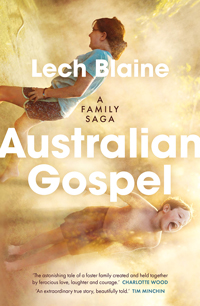
The sensational driving force of Australian Gospel, though, is Michael Shelley, the father of three of Blaine’s five foster siblings – and to a lesser extent, his wife Mary. The book opens with Michael, “the Australian Jesus Christ or a homeless sociopath, depending on your perspective”, kidnapping his three-year-old son, Elijah, from his foster home with the help of a gullible hitchhiker. Later, Elijah’s three younger siblings – two brothers and a sister – would be placed with the Blaines.
The author, who is the peripheral narrator of this memoir-of-sorts, grew up with the threat of “the Shelleys” appearing to re-enact the kidnapping of their first son. And one day, they did, following up with years of abusive calls and emails, and repeat visits to the Blaines’ homes and pubs. “Our lives were never the same,” Blaine writes.
In one sense, I found it challenging to write about this book – so much happens, it’s hard to meaningfully summarise it.

Blaine has been writing Australian Gospel for 11 years, drawing on his mother’s copious records and journals, writing and correspondence from Michael Shelley, and his own interviews. That long gestation is evident in the volume of detail he manages to cover. He’s not just telling a sensational family story, but using it to tell a wider – knottily nuanced – one about class, families, love, addiction, trauma, mental health, social aspiration and systems. The two couples, he writes, “wanted the same thing: a family to undo the damage of losing their own”.
Michael Shelley excelled at university, worked a corporate job for a mining company, then owned hotels. He once owned a Sydney apartment with harbour views. A diagnosed narcissist, he developed a messiah complex after a suicide attempt. He was 28 when he met Mary (then named Carrie), newly diagnosed with bipolar, in a psychiatric ward. “He felt himself in her company like no one else’s. She felt something less than numb.” Both had been married twice. Mary’s first marriage was to a television star she met when she was 16. Together, they believed the Bible was speaking to them and adopted “a Nazarene dress code”.
Not long after meeting and marrying, the Shelleys would renounce all their possessions (and Mary’s two children, who she deposited with their father), and embark on a life as nomadic preaching vagrants, periodically demanding food and shelter from strangers. The four children they had together would be progressively removed from them for neglect, as a result of their lifestyle. The couple would be intermittently institutionalised and jailed over the decades.
Blaine writes of the Shelleys’ effect on his family: “We felt as if Michael and Mary could hear our thoughts.” But he also writes: “We were incapable of seeing their frailties or feeling their pain.” In Australian Gospel, he attempts to redress this. On one occasion he even acknowledges, taking Mary’s perspective: “A police officer’s definition of kidnapping was a mother’s rescue mission.”
Blaine’s three foster siblings born to the Shelleys – all now adults – are very clear they are glad they grew up in his family, rather than with their parents, whose interjections in their lives often terrified them. The eldest Shelley child, Elijah, though, is more circumspect. His experience with the foster system was more complicated, too: he was moved between families, at least one of which was abusive. He once wrote to Michael Shelley, while attempting to make a connection after decades of no contact, that he wondered if the happiest years of his life were with him and Mary. Sadly, Michael’s hectoring reply did not reciprocate his eldest son’s generosity.
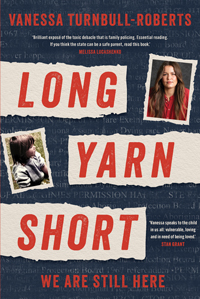
Vanessa Turnbull-Roberts, a Bundjalung Widubul-Wiabul woman and author of Long Yarn Short (UQP), was 10 when she taken from her bed and delivered into the foster care system. She was kidnapped, she writes. “I want you to imagine being tucked up in bed, about to close your eyes and then suddenly feeling this fear, this anxiety,” she implores the reader. She remembers her dad yelling from outside, “Bub … Big girl. I am so sorry, but they are coming to take you.” It’s an absolutely heartbreaking account.
Although she and her siblings lived primarily with their father at that time, her parents flexibly co-parented and a “whole community” shared responsibility for each other. “It was love and culture, but to the system it looked like kids running around without clear adult supervision. It looked like neglect.” Vanessa felt loved and cared for in a way she never would again during her childhood.
The night she was taken, her brother was with her mother, where he would remain – but her mother was somehow never considered capable of taking her, too. This was probably due to her diagnosis of schizophrenia, which she was managing. In her case notes, Turnbull-Roberts found this from her mother: “Vanessa will only see me as a friend and that’s okay. She won’t know me as her mother because you took her from me.” She writes about breaking down reading this. “Mum was and always will be my mum.” She treasures the few years she got back with her after turning 18, before her mother committed suicide.
Turnbull-Roberts went through multiple short-term foster placements before a permanent place was found. She stayed there from “eleven or twelve” until she was 18. She remembers only a few positive experiences (and one abusive one) among her short-term placements. Her favourite was with a queer couple, who “spoke so highly of my culture and allowed me to speak of my parents’ love”, but they were deemed inappropriate for long-term placement.
Subscribe for updates
When Turnbull-Roberts left the foster care system aged 18, she was too scared to ask her parents if she could live with them. They both died when she was 21.
Now the inaugural Commissioner for Aboriginal and Torres Strait Islander Children and Young People in the Australian Capital Territory, Turnbull-Roberts argues for abolishing the “family policing” system. Instead, she says, the money spent on it should go to supporting struggling communities and families, and promoting collaboration and unity. “If you strengthen a family to be supported with their children, you will change outcomes.”
The family policing system, she writes, takes a child from one world and places it in another. It defines neglect based on specific cultural definitions, and continues to disproportionately remove First Nations children from their families – at 11 times the rate of non-Indigenous children. “She probably thought she did the right thing,” she reflects on the case worker who took her from her family, “and that’s the problem.”
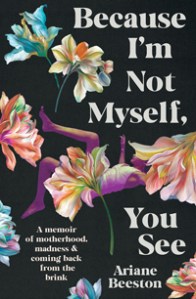
Ariane Beeston, a former child protection worker, experienced postpartum psychosis after the birth of her first child. In her extraordinary memoir, Because I’m Not Myself, You See (Black Inc), published earlier this year, she writes about the experience – and reflects on her “own complicity” in a “broken, racist system” that “disproportionately” subjects First Nations families to surveillance and punitive measures.
Beeston left case work before she became a mother, feeling she was doing more harm than good. She remains haunted by the children whose removal she was involved with.
A perfectionist, she held herself to punishing standards through her pregnancy, and describes the shame of “feeling nothing” when her son was first born – although she said “the correct lines”. As she doubted her performance as a mother, having internalised the surveillance of her former job, she began to worry her child would be removed. When she couldn’t eliminate a bad nappy rash, she hid from knocks at the door, convinced the social workers were coming. “I deserve it. It’s my turn,” she thought.
Later, when Beeston was placed in a psychiatric hospital with her child to treat her psychosis, she was filmed as part of the treatment. Of the experience, she reflects: “the act of being watched, of being the observed, not the observer … is one I won’t, I can’t forget”.
This exquisitely written memoir has stayed with me. In its incisive precision, it will resonate with many women who’ve felt shame at their inability to perform the job of mother to expected standards – not just those whose anxiety, like Beeston’s, crossed over into serious mental health problems.
I was particularly impressed by Beeston’s revelatory honesty not just about her experience of postpartum psychosis, but her experiences as a child protection worker. But what’s really notable and important about this book is the way she connects those experiences, and draws attention to her privilege as a mother struggling with serious mental health issues who never, really, faced the threat of having her child removed. The concept haunted her as a logical extension of her former work, but that kind of surveillance and judgment is – as she and Turnbull-Roberts both conclude – unevenly applied.
“How could it be that we didn’t understand that asking new mothers to jump through often increasingly difficult hoops while recovering from birth, adjusting to motherhood and facing numerous social challenges was setting them up to fail?” she writes. “That having their child taken from them was only going to make their existing mental health issues worse?”
Protecting families, and the best interests of children, is not simple. The authors of all three of these excellent Australian memoirs concede, to varying extents, that sometimes children need protecting from the circumstances of their families. Taken together, these three books tell a suitably complex story about what this means – and what Vanessa Turnbull-Roberts calls the family policing system. I haven’t emerged from reading them with clear conclusions. But I do have a more informed set of questions to grapple with.
Jo Case is a monthly columnist for InReview and deputy editor, books & ideas, at The Conversation. She is former bookseller at Imprints on Hindley Street and former associate publisher of Wakefield Press.
Want to see more stories from InDaily SA in your Google search results?
- Click here to set InDaily SA as a preferred source.
- Tick the box next to "InDaily SA". That's it.
Free to share
This article may be shared online or in print under a Creative Commons licence