Historic toy exhibition is a step back in time
Even as a nine year old, Luke Jones had an eye for classic, collectable toys. Over the past 40 years Luke has continued to collect, curating a rare and historic range of toys made between 1880 and the 1960s. Now, for the first time, that collection is being shared with the public in an exhibition at the David Roche Museum.
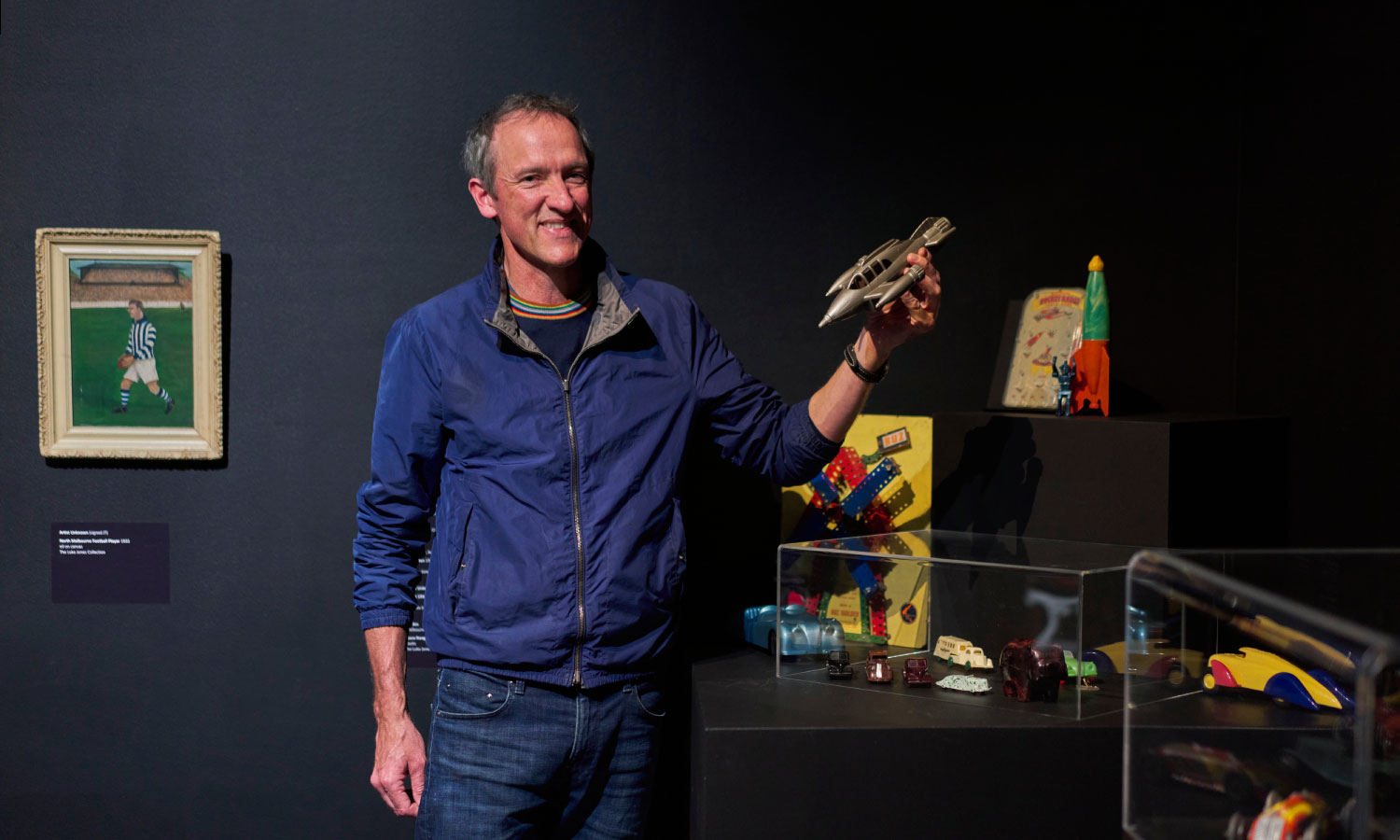
Luke Jones was just nine years old when he bought his first collectable toy – a Coca-Cola truck he found at Small and Whitfield Auctions.
The truck was from Northern Italy, circa 1950s, and the young Luke had saved the money he’d made as a paper boy in North Adelaide to make the exciting purchase.
“I wanted to collect something in particular, so old toys was the collection of choice,” say Luke, now 50 years old. “I went to the auction with my father and bought the truck for $115 in 1983.
“I was earning money and I didn’t want to fritter it away. I wanted to look after my money, but I also wanted to spend it, so collecting was my kind of pathway to do two things at once.
“I’m very confident that that Coca-Cola truck, I don’t have any sort of provenance or actual history of it, but I’m really confident that it would have been brought out to Australia with the waves of migrants from Europe, in particular Italy, after the Second World War in the mid-50s, because it’s not a toy that I think would have been sold in Australia. It’s impossibly rare, quite an unusual thing.”
That first toy sparked a lifelong passion for old toys and Luke has spent the past 40 years compiling an incredible personal collection of toys made between the 1880s to 1960s.

Now, for the first time ever, the public can now enjoy Luke’s collection thanks to an exhibition currently on at the David Roche Gallery in North Adelaide titled Australian Toys 1880-1965: The Luke Jones Collection.
“It’s just bloody marvellous,” Luke says of the exhibition. “It really is a dream come true for a collector to be able to put my collection on public display. It’s very rewarding.”
The exhibition includes around 380 items which Luke says is about half of his historic collection. One of his favourite toys is a spectacular 1880s carved wooden Noah’s Ark, found in England.
You might like

“That’s one of the things which could be a little bit of an indulgence for me as a collector, but it’s a toy where the exact model was sold in Australia, because I’ve seen them come out of local estates, and I wished I’d bought the ones that I saw a couple of decades ago, but I didn’t and I’ve always wanted one.
“It’s in remarkably good, original condition for something that’s probably 140 years old. There are 75 pairs of animals, so 150 individual animals that go into this ark.
“The ark itself is about 60 centimetres long, it’s quite big, with a sliding door so the animals can fit inside. And then it’s got Noah and his family as well as all the animals arranged out in front of it. It’s just a remarkable toy.”

Other highlights of the exhibition include a toy submarine made from the ballast of a Japanese mini submarine which sank in Sydney Harbour in 1942, a chicken in a cage toy made in the 1920s which belonged to Luke’s great uncle, refined lithographed tinplate toys made in the 1920s and mass-produced toys that emerged during the post-war period including a Glenn Holden Special.
Luke says his parents, father Robert an artist who now lives in France, and his mother Caroline, supported his collecting as child, taking him to auctions and then bidding for him when he was at school.
“Mum and Dad were very supportive,” Luke says. “Dad, as an artist, probably passed on some appreciation of the visual qualities of these toys.
“Mum was a nurse and she would do night duty and then spend some days bidding for toys for me at auctions. They were both quite influential in their different ways.”
Now, Luke’s wife Aylwen Dennis offers that same support when it comes to her husband’s collection, which he manages to keep mainly in display cabinets in one room at their home, as well as on display around the house – which he describes as not a “grand palace”.
“I’m very fortunate because each time I bring home a new toy Alwyn doesn’t blink, actually,” Luke says. “She’s very, understanding is not quite the right word, she really appreciates what I do and appreciates the passion and I think she appreciates that I’ve got some discipline as a collector. I think I’m not haphazard about it.”

The couple has two children, Teddy, eight, and Florence, five, and Luke says he has a new appreciation of toys now that he can view them through the eyes of his children.
“I’ve always collected the toys just because I love them as objects and I love them just intrinsically for what they are and what I’m looking at, but when I see a child playing with toys, it’s a whole different world,” he says.
“Their brains are just constantly learning and absorbing information and they are understanding the world around them by playing with the toys and through their own personal experiences in playtime, it’s just this constant information going into the brain.”
Subscribe for updates
Not that Luke’s children are allowed to play with all of his collection because most items are out of bounds – which his children intrinsically understand.

Horses also feature throughout the toy collection given Luke, an architect who runs his own firm, is an accomplished equestrian who competes in the sport of eventing. His architectural firm, Luke Jones Architects, also specialises in designing equestrian facilities, as well as residential homes.
“Another favourite is a remarkable wooden toy, sort of horses and hounds, that was made in Adelaide in about 1926 or 1927, and it’s a fabulous piece of local craftsmanship,” Luke says.
The Roche Museum exhibition came about when director Robert Reason heard Luke speaking at an Adelaide’s Society of Collectors meeting about his book Australian Toys: A Collection published in 2019 by Melbourne Books.
The collection also gives a fascinating historical insight into how societal views have changed over the years. One of the most controversial pieces in the collection, which is not part of the exhibtion, is a tea set from 1925 with illustration of the “Ten Little N……”.
“There are some toys that I have that are just downright racist,” Luke says. “I don’t even like the words politically incorrect because that doesn’t cover it, they are racist and terrible but to me, it is also fascinating because even through the humble toy, you can see all sorts of social things going on.
“The tea set is illustrated with 10 sequential images of how 10 little African boys met their deaths and it is gruesome… it’s hardcore racist and this is on a little girl’s tea set from 1925.”

Luke says he is still very much a collector and although he is not chasing toys as urgently as he once did 15 or 20 years ago, he is always on the lookout. Just last week he purchased a Mickey Mouse truck made in 1935.
He says he has no plans to sell his collections because “I’m not in the process of building something that I’m going to sell, but at the same time, there is obviously inherent value in the objects”.
Being able to take his beloved toys out of his home and share them with the public is something that makes Luke feel “unbelievably happy”, he says.
“It’s quite a simple thing,” he says. “I’m just happy and there’s a point of incredulous as well because I’m proud of the whole thing but there are a couple of cabinets and groupings of toys that I’m really particularly proud of. I can stand in front of one of those cabinets, feeling happy and slightly incredulous that I’ve managed to achieve this.
“For me it’s not about the thrill of the chase or the hunt or anything like that. It’s about having these toys and about understanding them and having them as part of a collection and I get a lot of joy out of the whole structure of the collection. That’s kind of important to the way I see it.”
The exhibition also includes a fun trail for children to participate and find objects along the display.
Australian Toys 1880-1965: The Luke Jones Collection is on at the David Roche Museum until August 24. For more information visit rochefoundation.com.au.

Want to see more stories from InDaily SA in your Google search results?
- Click here to set InDaily SA as a preferred source.
- Tick the box next to "InDaily SA". That's it.
Free to share
This article may be shared online or in print under a Creative Commons licence