Music review: VOCES8 with Adelaide Chamber Singers & Aurora Vocal Ensemble
British ensemble VOCES8 demonstrated their dazzling prowess at UKARIA’s A Cappella Academy, with their public performances also showcasing local vocal talent.
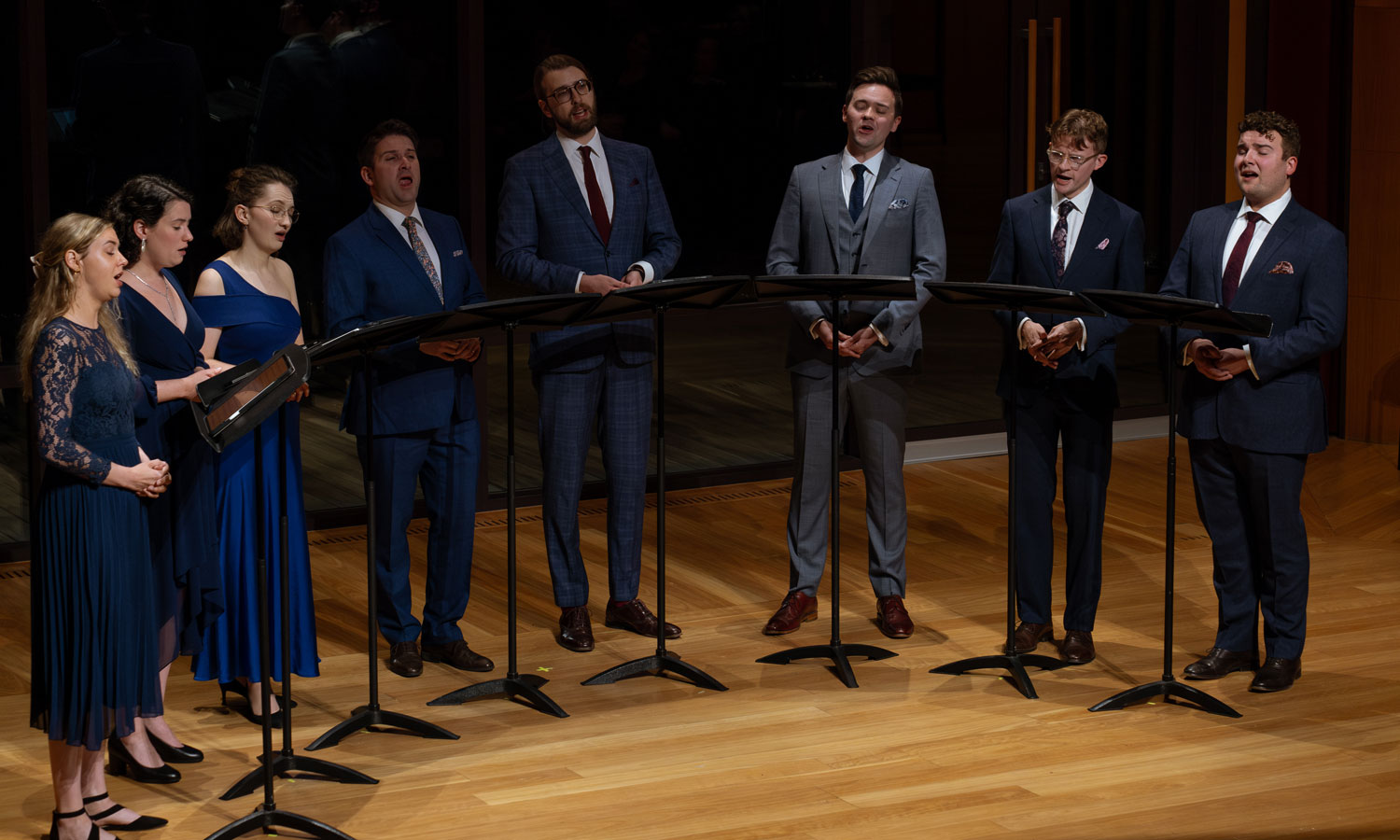
VOCES8 presented three concerts as part of the 2024 A Cappella Academy, performing alongside Adelaide Chamber Singers (concert one), Aurora Vocal Ensemble (concert two), and Festival Statesmen Chorus (concert three). The first two are reviewed here by Edmund Black and Graham Strahle.
VOCES8 with the Adelaide Chamber Singers
By Edmund Black
A cappella vocal repertoire is often religious in nature. Indeed, the term itself literally means “in the style of the chapel”, and this can often subtly influence the character of a vocal performance. The perceived sanctity of a choir singing unaccompanied can create a certain sense of detachment for the audience, who marvel in the transcendence of the music, but feel oddly unwelcome. It is almost as if they are being sung at rather than sung for.
However, UKARIA’s A Cappella Academy, directed again by former King’s Singers member Timothy Wayne-Wright, seeks to challenge this division between choir and audience. When introducing the first of this year’s three concerts, Wayne-Wright spoke directly of the humanity of singing, and how the voice is an instrument that lives within each and every one of us – chorister and audience member alike.
This year’s ensemble-in-residence, UK-based VOCES8, are perfectly placed to celebrate this shared humanity. They are a group that cannot be pinned down, with great diversity in their repertoire, a wide variety to their performance practices, and a whole host of outreach and education initiatives.
While they still include some canonical choral works in their programs, they most definitely are not your average choir, and they began their set with an affirmation of this duality. Although the song in question, Arvo Pärt’s motet “The Deer’s Cry”, is explicitly religious, they left the end of each phrase hanging in the air, ethereal and unresolved, as if inviting the audience to join them in prayer, rather than directing them to just sit and listen.
VOCES8 announced the program from the stage, the repertoire having been selected during the Academy’s teaching days, and for the most part presented two songs at a time, with no break for applause in between. This led to several unconventional pairings, but the resulting eclecticism felt incredibly natural.
Although the 13th-century Icelandic hymn “Heyr himna smiður” (“Hear, Smith of the Heavens”) felt like an unusual prelude to Mumford and Sons’ “Timshel” (arranged by VOCES8’s arranger-in-residence, Jim Clements), the contrast in genre, language and chronology felt unimportant – almost unnoticeable.
You might like


Indeed, even though the hymn’s text exalts submission to God’s will, and “Timshel” (which is a Hebrew word meaning “thou mayest”) expresses the joy of exercising one’s free will, these two sentiments felt complementary rather than conflicting. The focus was always on the miracle of communicating the uncommunicable, and never on rigid conformity to convention.
The vocal brilliance of this celebrated UK ensemble was on display at all times. Many of their arrangements featured fearsomely dense, dissonant passages, but each one was handled with poise and pinpoint accuracy. In keeping with their engaging onstage manner, this accuracy was never robotic. Serpentine key-changes were relished rather than recited; gospel-inflected solos were graceful and organic rather than overbearing or dramatic.
Their set ended with a selection of swing tunes (Nat Cole’s “Straighten Up and Fly Right”, and a combined arrangement of “Fly Me to the Moon” and “Come Fly With Me” by Alexander L’Éstrange). These were lighter in character. Although they were not quite as substantial as the previous pieces, they were wonderfully entertaining, and in keeping with the core principles of the A Cappella Academy, helped to make the relationship between performer and audience closer.

After the interval, it was over to the Adelaide Chamber Singers, who had been workshopping intensely with VOCES8 over the course of the week. Under the direction of Christie Anderson, they were clearly eager to take up the welcoming approach of VOCES8, and were very successful in doing so throughout their program of complex and intriguing music. Most significantly, they premiered the work “Ah, Moon – and Star!”, composed by Luke Howard and commissioned by the ACS Supporters Fund, admirably conveying the whimsy of the text (an Emily Dickinson poem) without undercutting its emotional weight.
Other highlights included their extremely evocative and atmospheric performance of Juliana Kay’s “Peat Brown Hours”, and their heartfelt rendition of “Nearer, My God, to Thee”, arranged by Adelaide’s own Carl Crossin.
As the night drew to a close, VOCES8 joined ACS for a performance of “Resonance” by Canberra’s Sally Greenaway, who was present in the audience. Before the combined choir began, she briefly introduced the piece as an expression of the wonder of choral music, and as the combined strength of the two choirs filled the room, the joy of their shared experience was palpable. For the opening night of this wonderful Academy, there could not have been a more fitting conclusion.
Edmund Black is the 5th recipient of the Helpmann Academy InReview Mentorship. He is working with Graham Strahle to write a series of articles for publication in InReview.
VOCES8 with Aurora Vocal Ensemble
By Graham Strahle
The second day of UKARIA’s A Cappella Academy produced some true surprises. In the first place, the focal points of this annual series of masterclasses and workshops are the public performances given by its tutors, in this case celebrated ensemble VOCES8. To hear one of the top-tier vocal groups in the world in action is indeed a treat, even if their brackets in these concerts mainly consisted of lighter material.
But the groups they are tutoring can rise spectacularly to the occasion. Adelaide Chamber Singers certainly did so on day one, as reviewed above. Just as enjoyably, VOCES8 repeated their magic in a follow-up showcase bracket on day two. Their execution was close to flawless, and their onstage manner again endearingly bright and lively.
Subscribe for updates
Few could have imagined, though, how well Aurora Vocal Ensemble gave of themselves in the second half. We’ll get to that anon but their record of achievement speaks for itself with appearances, inter alia, at two Adelaide Festivals, WOMAdelaide in 2023, and this year’s Adelaide Fringe.
To begin this second Academy concert, VOCES8’s exacting standards seemed to raise the bar impossibly high. Starting with “Let My Love Be Heard” by US composer Jake Runestad, the octet rose from ineffable calmness to a resounding climax – this piece’s trajectory is similar to that of Barber’s “Adagio”. The singers’ line and diction were immaculate, and as the crescendo rose and passions opened out, the result was spine-tingling.
These eight singers can maintain the steadiest composure in quieter, more meditative songs. The way they think and breathe together so beautifully was beyond impressive in Caroline Shaw’s “and the swallow” and Norwegian composer Ola Gjeilo’s Latin motet “Ubi Caritas”.
It is particularly rewarding to hear them sing Eric Whitacre. Their precision and rapture were glorious in “All Seems Beautiful to Me”, a song to poetry by Walt Whitman that exhort us to goodness and optimism.
Two memorable arrangements of pop classics followed. Alexander L’Estrange’s version of Simon & Garfunkel’s “The Sound of Silence” is a beauty, and bass singer Dominic Carver proved in this that he possesses all the deep resonance it demands. Meanwhile, Blake Morgan’s attractive tenor and easy, flexible folk-style were just right for Jim Clements’ setting of “Vincent” by Don McLean.
Closing out VOCES8’s set were two entertaining showtunes, Irving Berlin’s “Cheek to Cheek” and George Gershwin’s “Slap that Bass”. Both were delivered with slick, well-honed vocals and choreography.

It was then Aurora Vocal Ensemble’s turn. After the count of three, 25 young women began a rhythmic drill of footstomps and slaps to either side of the body in “What Happens When a Woman” by Chicago composer Alexandra Olsavska. This gospel-style song about female empowerment immediately gripped the stage. These singers were terrific. Propelled by self-belief, they generated a ton of energy and were clearly enjoying themselves.
A change of pace in the intimate Hebrew song “Memory’s Wavering Echo” by Kenneth and Kirsten Llampl showed just how well this large choir sings as one. Their feeling of mutual connection and complete trust in their conductor, Christie Anderson, was palpable and moving.
Not to be shaded by VOCES8, they put their all into another Latin song by Gjeilo, his “Northern Lights”. It was intense and pure, and one began noticing in this just how passionate Aurora’s singers are about what they do.
Their eyes lit up in Ēriks Ešenvalds’ hymn of praise to nature, “Spring, the Sweet Spring”, adding whistling birdcalls and drone effects of fingers running over wine glasses. This and Simon Wawer’s equally enchanting “O Du Stille Zeit” showed how beautifully Aurora blend their voices.
They sang Greg Jasperse’s “VoiceDance” with spirited energy and the Irish folksong “Maid on the Shore” with wonderful colour. By their last piece, Finnish composer Laura Jēkabsone’s joyful “Kuulin äänen”, Aurora had won every heart in the house.
Anderson’s choir had stolen the show. Barnaby Smith, VOCES8’s countertenor and artistic director, came to the stage and just said “Wow”.
In truth, it was testimony to how much they’d gained from VOCES8 in this Academy, and in the spirit of unity, both choirs joined for a new piece by Taylor Scott Davis called “Hold Fast to Dreams”. Newly commissioned and receiving its premiere, its uplifting words served as a message to all.
Three concerts were presented as part of this year’s A Cappella Academy at UKARIA Cultural Centre: VOCES8 with Adelaide Chamber Singers (June 14), VOCES8 with Aurora Vocal Ensemble (June 15) and VOCES8 with Festival Statesmen Chorus (June 16).
Want to see more stories from InDaily SA in your Google search results?
- Click here to set InDaily SA as a preferred source.
- Tick the box next to "InDaily SA". That's it.
Free to share
This article may be shared online or in print under a Creative Commons licence