Music review: She Speaks mini-festival brims with energy
She Speaks was back again this year with an especially inspired choice of music, highlighting that attitudes towards female composers still need to change.
Now that we have had three ASO She Speaks mini-festivals, there might be a longer-term view we can take on this event that celebrates the work of women composers. Its job of redressing the gender imbalance that has stood for too long in classical music is hardly done yet, and since its beginning in 2021, we might be able to say that it is one of the most vital exploratory projects the orchestra has ever mounted.
The music speaks for itself. Programmed this year by Anne Cawrse and Belinda Gehlert, the 2024 edition of She Speaks brimmed with rewarding music, leaving one in no doubt that great swathes of music still need to be resurrected and that attitudes still need to change.
Joan Tower was one of several composers who particularly impressed over the event’s two days. Honest and very skilfully written, her works stand proudly alongside any male composers born in the interwar years. Her “Fanfare for the Uncommon Woman No.1”, of 1986, is a humorous repost to Copland’s “Fanfare for the Common Man” and served as a splendid concert-opener with its rippling energy. Also on the program was her “Chamber Dance” of 2006, a vigorous piece that places solo instruments against one another in a finely wrought rhythmic tapestry of sound.
Tower’s music is immaculately honed and memorable – but to this day it remains unaccountably hard to track down in recordings. Sadly, that goes for many of the composers who were represented at this festival.

Dobrinka Tabakova’s “Barbican Glade” is an attractive, gently pulsing piece that we’ve heard the ASO play before (in April). Both it and Missy Mazzoli’s “These Worlds in Us” evoked variegated moods of nostalgia and similarly impressed with their skilful writing.
Cawrse and Gehlert each contributed new works to the final She Speaks concert. Gehlert’s “Diving into the Wreck”, based on poetry by the radical feminist poet Adrienne Rich, was of special interest because it is an ASO commission and the first major orchestral work by this well-regarded Adelaide composer and violinist; previously a member of Zephyr Quartet, she now frequently plays in the ASO’s violin desks. “Diving into the Wreck” takes the metaphorical idea of a journey into realms of personal experience. It’s a piece of cinematic scale and vision, employing clusters of layered sound and folk-like melody in its musical “verses”. Beginning with deadly seriousness, it opens out stirringly with majestic harmonies of horns and strings.

Cawrse’s concerto for cor anglais, “The Rest is Silence”, is a superb new work of thoughtful sophistication. Coincidentally, it also takes its inspiration from Rich – specifically her statement that “The impulse to create begins – often terribly and fearfully – in a tunnel of silence”. Cawrse translates it beautifully to music. The solo cor anglais pursues a simple, eloquent but lonely path against delicate textures in orchestra that acquire an increasing harmonic complexity. Each phrase begins with wisps of sound and ends with a single note from glockenspiel that rings out and fades to silence. “The Rest is Silence” is a highly finessed work, and Celia Craig played its solo part with perfect poise and serenity.
Fellow Australian composer Holly Harrison also garnered much attention for her contrasting pieces. “Hotwire”, for viola and orchestra from 2019, was She Speaks’ invigorating highpoint. This concerto-like work is a rhythmic rollercoaster, combining grungy rock ’n’ roll, boogie woogie and all-round frenetic fun in a sonic matrix that never lets up. Justin Julian, the ASO’s much-admired viola player, played mesmerisingly well in this as soloist. His gestural timing and technical prowess were everything the piece could have asked.
Subscribe for updates
One felt similarly about the ASO. They played excellently throughout this concert. Their clarity and precision under conductor Luke Dollman were outstanding.
Equal fun was to be had in Harrison’s “Bend/Boogie/Break” in a smaller concert given by Elder Music Lab, a new ensemble of student musicians at the Elder Conservatorium. Sally Greenaway’s gorgeously rapturous “Poems I, II & III” for violin and piano, followed by Julia Wolfe’s totally teasing “East Broadway” for toy piano and kids’ boombox, were winners.
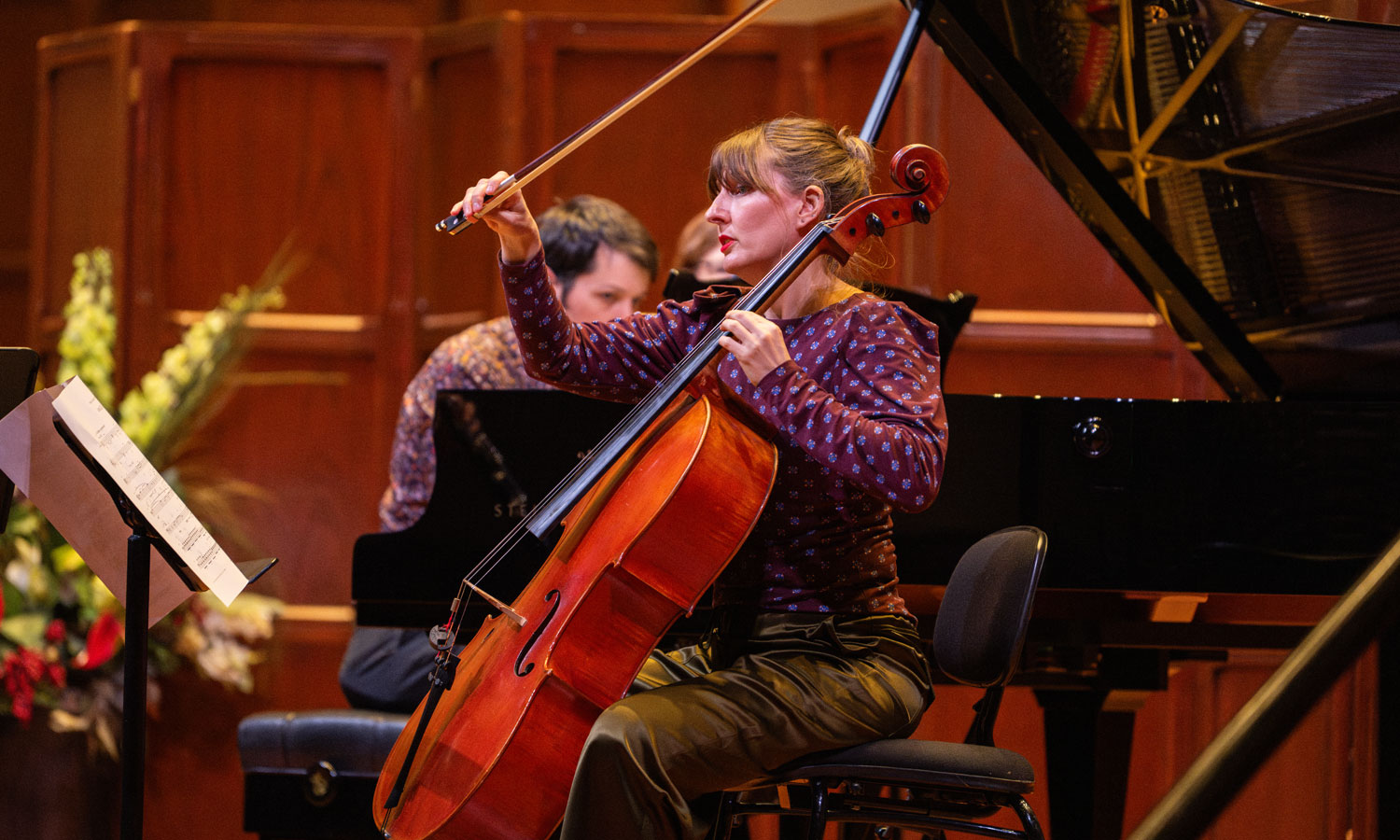
A most hypnotically entrancing piece came earlier in this mini-festival. This was “Julian Suite III: Angelus” by Mary Finsterer. Consisting of gently lopsided repeating chords in the piano with conversation-like additions of clarinet and cello, it exercises a rare spell. Pianist Michael Ierace, clarinettist Lloyd Van’t Hoff and cellist Gemma Phillips played it exquisitely. One wanted it to never end.
Caroline Shaw’s widely popular “Entr’acte” has a similar magic about it with its tantalisingly ear-tugging repeating phrases. Joining Phillips for this were violinists Lachlan Bramble and Emma Perkins, and violist Linda Garrett. Elizabeth Maconchy’s gritty, introspective String Quartet No.6 from 1950, and Jennifer Higdon’s zestful “Dash”, were two other worthy discoveries in this partnering program of chamber music.
The She Speaks mini-festival, held from May 31 to June 1, encompassed four concerts at Elder Hall and Madley Studio.
Want to see more stories from InDaily SA in your Google search results?
- Click here to set InDaily SA as a preferred source.
- Tick the box next to "InDaily SA". That's it.
Free to share
This article may be shared online or in print under a Creative Commons licence