In the Studio with Olga Sankey
The relationship between image and text has long fascinated printmaker Olga Sankey, who has embraced the new opportunities created by digital technology.
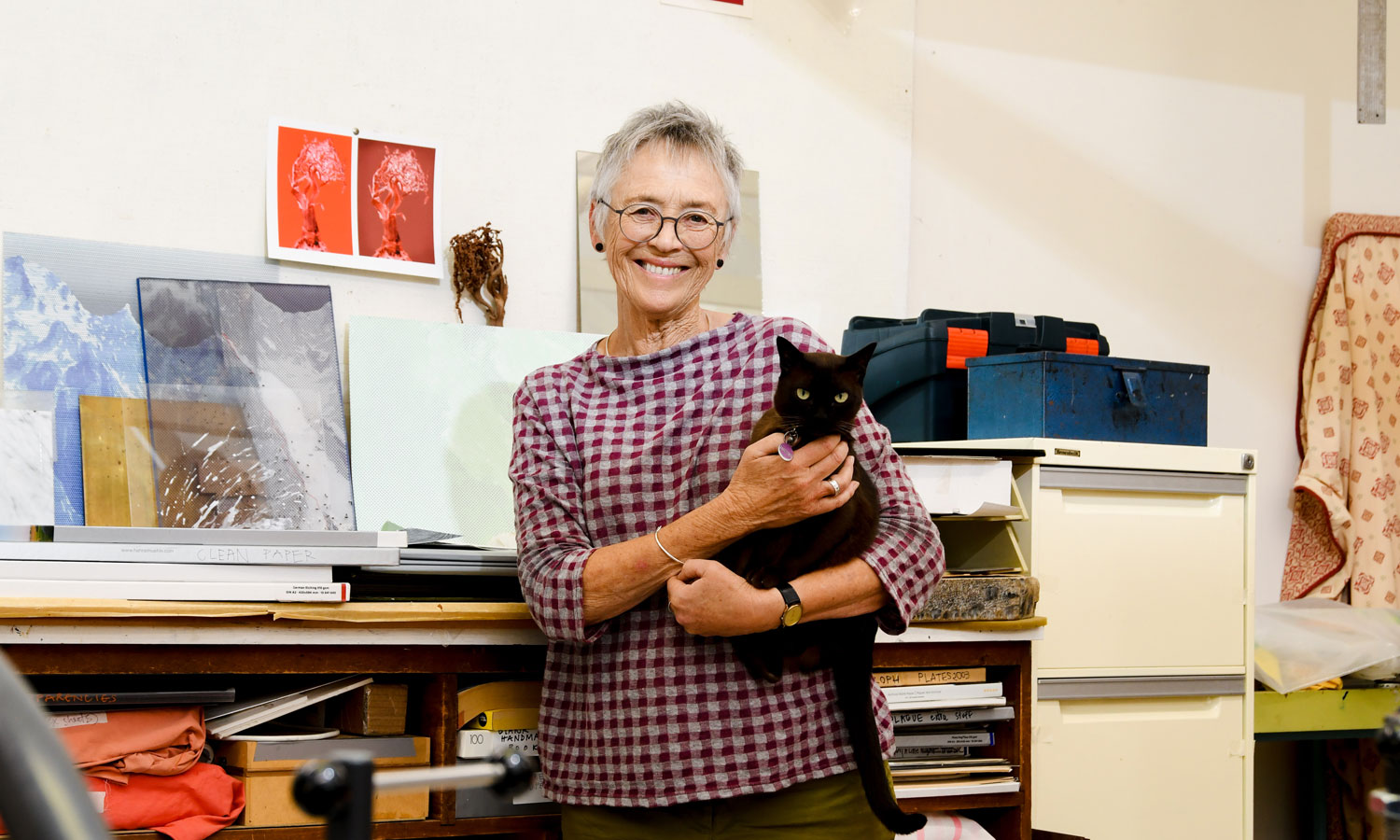
Olga Sankey doesn’t like simply pottering around her studio. She needs direction and deadlines, otherwise working out where to start – or how to start – can be overwhelming.
The printmaker comes in each day with thought-out concepts, after ruminating in bed in the early hours of the morning. But they are simply a starting point.
“I end up actually working out that the ideas I had are not actually as good as I thought they were,” she says, laughing.
“In the cold light of the morning, and after coffee, I think, ‘Oh, that idea I had at 4am, actually, that’s kind of really silly’, or ‘that’s too obvious’.

“But I’ve found that it doesn’t work for me to just come in here and hope something will hit me. I actually have to have a pretty clear vision, not quite how it will look, but the concept.
“And then, you know, things happen. Things break, and it’s not always bad.”
Sankey’s studio is tucked away at the back of the well-kept garden at her Underdale home, past a fig tree and a deck on which her cats Nero and Luna sit.
The studio is warm, layered with different materials, books and ideas. It’s also neat – which not a surprise, since the artist says tidying up often helps with her creative process.
Sankey comes from a family of artists, but was reluctant to embrace the path that seemed set out for her. “Of course I rejected it,” she recalls. “I didn’t do want to do art at all.”
You might like

She originally studied English literature, but then after the Whitlam Government made university education free, she decided to do a second degree.
“I sort of got over the fact that I was trying to escape from art, so I went to art school. I had actually done a little bit of printmaking, just at a summer school, so I went in knowing I wanted to study that.”
Sankey attended the South Australian School of Art in the late 1970s and early ’80s and spent a year training in lithography in the Italian city of Urbino, Sankey. An interest in language penetrates her art, which usually begins with text – perhaps the title of a movie or something from a newspaper that has grabbed her attention.

As part of the 2024 Guildhouse Collections Project with Flinders University Museum of Art (FUMA), Sankey is one of five artists who have been commissioned to create new works in response to the museum’s collection of political posters and prints from the 1970s. The curatorial theme for the project is The Disquiet.
Sankey selected a 1975 poster by South Australian printmaker and feminist art trailblazer Ann Newmarch titled Two Versions, explaining that she was first attracted to it because it featured text – specifically, the words “4 colorful versions of the truth”.
“I’ve done work before about different perspectives, different viewpoints: Your story, my story. Mine’s right, yours is right. And perhaps the universal one: People live, people die,” she says, offering examples of the kind of ideas that inform her practice. “But all the stuff in between is kind of what you choose and what I choose.”
Sankey is responding to Newmarch’s poster by making three books that will be on display as the centrepiece of her work. They will be black, white and, as Sankey describes it, “work that reveals itself slowly and is more than just a one-liner”.
“My whole thing was really about how we’re trapped, within digital information,” she says.
“The three books, they’re all about blocking information, failing to see what’s really there – confirmation bias.
“We have so much information, much more than we ever did before, but you can be just as blind because of either the way it’s presented, what’s left out, what’s put in, and what you want to read – you’re going to read what you like reading.”

The digital age has influenced not only the subject matter of Sankey’s practice but also her methodology. While she started her career focussing on the art of lithography, a plethora of new opportunities has opened up in more recent times.
“Lithography is extremely time-consuming. It was a logical thing to move into digital. For me, this computer thing has been liberating.”
Subscribe for updates
Hand-drawn elements still play a role in Sankey’s practice, but digital technology has allowed for creative collages, and layering in a way that was never possible before.
“I don’t love the labour of hand-printing any more, which I used to quite like the ritual of. But I love creating stuff in layers. I love the way you construct it.”
Exploring truth and how we construct it has been a theme of the printmaker’s work since the early days of her career.
One of her key works, Tenet, which was created in 1999, responded to Dürer’s Rhinoceros. German artist Albrecht Dürer’s famous 1515 linocut showed a rhinoceros with a horn on its back and armour-like plates covering its body.
“His rhinoceros, which was so widely circulated, was so incorrect, because it was based largely on a verbal description, and a really crazy little sketch that was quite wrong,” she says.
“The power of that, for me, was the power of the printed image to really shape people’s reality.”
Sankey used to collect personal columns from the newspaper as a case study for constructions of self.
“They were just very funny,” she says. “I did a series that was postcard work that was called I Wish You Were Here, and it was all the adjectives that people use to describe themselves, [which are] quite different from reality.
“It was really that tension between the image and the word – the discrepancy – and then it came to how we read things, what we chose to see.”

For Guildhouse’s 2022 ART WORKS program at Adelaide Town Hall, Sankey created two prints using sandblasting that were designed to sit side by side and examined the duality between image and text. The prints feature the words “Take Shelter”, but these are legible only from a certain angle.
“This was very much saying, ‘the message is there but unless you’re in the right spot, and focused, you will miss the disaster’,” she explains, looking at the prints she has laid on a bench in the centre of her studio.
In this arguably post-truth age, perhaps there has never been a more appropriate or urgent time to examine the relationship between image and text. So how does something like generative AI shape the role of the artist?
“AI responds to data, questions and material that it’s fed,” Sankey says. “But as yet, AI isn’t able to ask questions, which is what art aims to do.
“I wonder whether they’ll ever be able to match the crazy and illogical thought sequences that humans are capable of, and which generate truly surprising and original artworks.”
Like, perhaps, those creative ideas that get Olga Sankey’s brain whirring at 4am.
Read more about Olga Sankey and her artwork on her website, and about the Guildhouse Collections Project here.
In the Studio is a regular series presented by InReview in partnership with not-for-profit organisation Guildhouse. The series shares interesting stories about South Australian visual artists, craftspeople and designers, offering insight into their artistic practices and a behind-the-scenes look at their studios or work spaces. Read our previous stories here.
Want to see more stories from InDaily SA in your Google search results?
- Click here to set InDaily SA as a preferred source.
- Tick the box next to "InDaily SA". That's it.
Free to share
This article may be shared online or in print under a Creative Commons licence