Diary of a Book Addict: Lives, and crimes, of the times
This month, our columnist explores five books that interrogate changing values and ethics: a biography of writer Frank Moorhouse, a schoolyard psychological thriller, two novels with true crimes at their centre, and a book by a researcher who goes undercover with extremists.
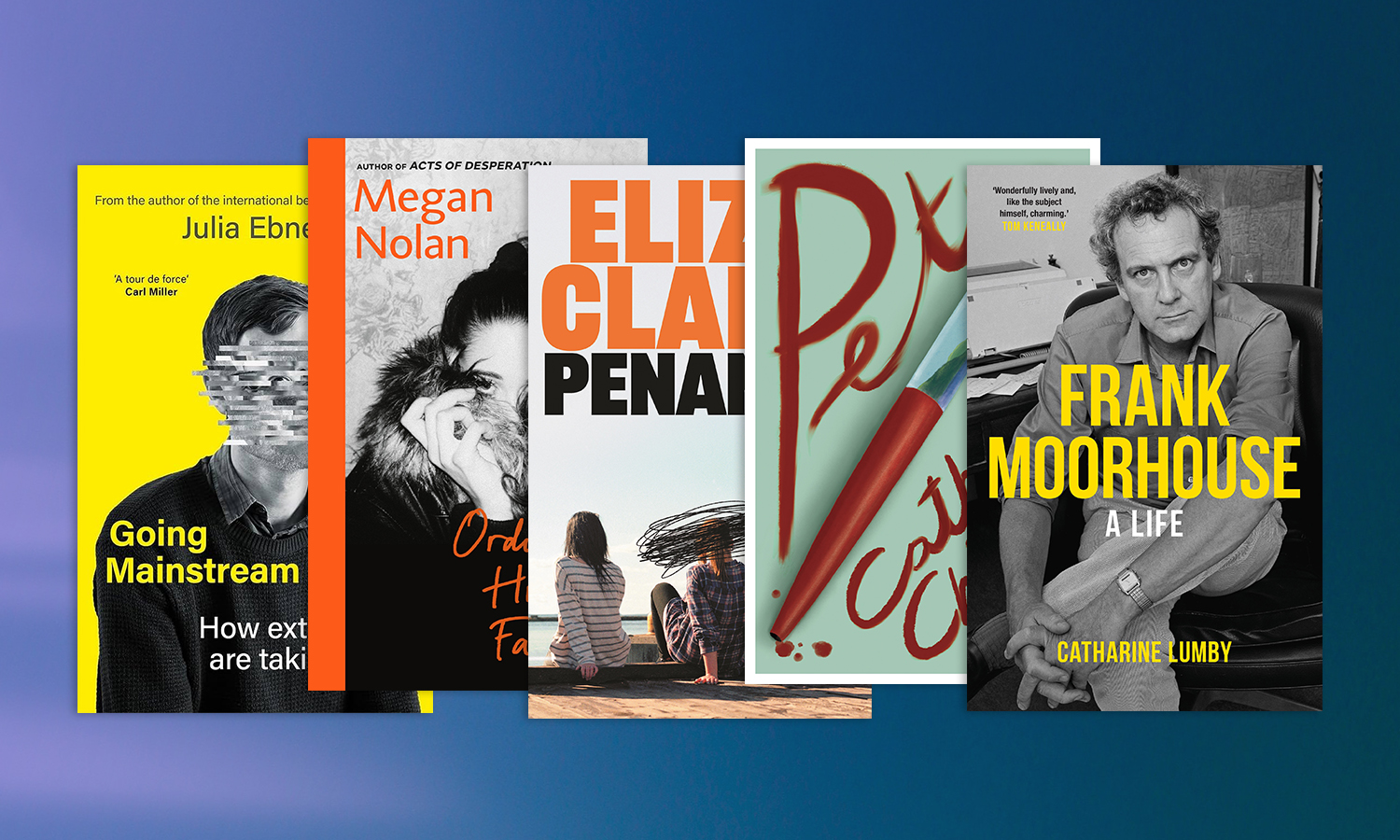
Catharine Lumby was writing the conclusion to her biography of great Australian writer Frank Moorhouse when he died last year, on June 26. And now, just over a year later, Frank Moorhouse: A Life (Allen & Unwin) has finally been published.
Lumby describes the book as “an attempt to connect the life and work of an important Australian writer, and to show how the two were inextricably linked”. It reminds me of Bernadette Brennan’s excellent A Writing Life: Helen Garner and Her Work (Text Publishing), which I often revisit alongside Garner’s books. Both writers map their subject’s life and work on a shared grid, drawing on extensive archives.
 Moorhouse invited Lumby to write his biography, and he fully cooperated in the project. The first chapter opens with him shucking oysters, just outside his home town, Nowra, on a joint visit to interview his brother for this book. This easy intimacy sets the tone. We’re a passenger on this journey, joining the meaning-making process – not reading a report once it’s over.
Lumby’s book is not strictly linear, but moves forward in thematic loops. I love this approach, and the way it privileges exploring connections over telling a comprehensive life story. Like Moorhouse’s own writing, the book intricately knits its protagonist into his social context, tracing his involvement in crusades against censorship and for creative copyright payments, and his support for gay liberation, feminism and Aboriginal rights. It shows how he was shaped by his times and shaped them in return, while putting the specificities of his character and obsessions centre-stage.
Moorhouse was “a man who was wedded to and fascinated by rules and rituals while equally prepared to rail against the overreach of the state and bourgeois morality”. Of course, this blend of innate conservatism and rebellion is reflected in his most famous character, Edith Campbell Berry, in his two League of Nations novels, Grand Days and Dark Palace, and the final in the Edith trilogy, set in 1950s Canberra, Cold Light.
It’s also reflected in Moorhouse’s private life. His prolific output was aided by his structured work habits and he was famed for his affinity for precise social rituals, like the right way to make his beloved martinis. “I think rules fascinated him precisely because he liked toying with their boundaries,” writes Lumby.
She explores how he didn’t fit into the strict social boundaries of the world he was born into, including in terms of his sexuality, as a bisexual who (like his British diplomat, Ambrose Bierce, in the Edith books) enjoyed cross-dressing and once described himself as “bi-gendered” or “inter-gendered”.
While most of this biography, and Moorhouse’s work, is in line with progressive mores, Lumby doesn’t shy away from more difficult material. Moorhouse’s border-crossing and fondness for pushing taboos crosses from admirable to challenging in a chapter that includes reflections on an unpublished erotic novella, Sonny, which Lumby says is “perhaps unpublishable”; many readers will “with good reason” find its subject matter “abhorrent”. Sonny is about “a beautiful, young girl-boy” whose experiences include “an induction into intercourse” by his mother, then “a lesson in receiving anal sex” from the head counsellor of his boarding school. (I should say, there’s absolutely no suggestion this work is rooted in life.)
You might like

Lumby reflects that the 1970s libertarianism of Moorhouse’s formative years as a writer was epitomised by rebellion against “the puritanical mores of mainstream Australia”, particularly sexual repression. Today, she says, this can sit uneasily alongside a contemporary morality shaped by the post-1990s revelations of endemic child sexual abuse in institutions and the family – one that, I think, privileges avoiding potential harm over confronting taboos.
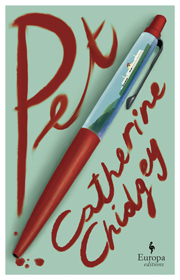 Catherine Chidgey’s slyly incisive literary psychological thriller, Pet (Europa), primarily set in 1980s New Zealand, is an indictment of the mainstream middle-class mores Moorhouse and his peers pushed against. Equally, it’s an indictment of children’s vulnerability to predation (not sexual, I should say) in an era that was not especially alert to potential harm by authority figures – and indeed, a society where they were socialised to unquestioningly trust authority and imbibe its values.
Twelve-year-old Justine, who recently lost her mother to cancer, is – like her classmates – captivated by her charismatic teacher, Mrs Price. New to town, Mrs Price drives a white Corvette, resembles Rebecca De Mornay in Risky Business and makes her students, who compete to be in her inner circle, feel special when her attention is on them.
After Justine has a seizure and Mrs Price drives her home (and meets her widower father), the girl becomes her chief “pet”, earning the opportunity to pick up her diet shakes and her pills, among other chores. It’s also Justine’s entry ticket to the popular crowd. Her Chinese best friend Amy, whose family owns the local greengrocer, is not invited. As Justine chooses validation from the people who seem to matter socially over a deep, authentic friendship and a family that feels like an extension of her own, Amy becomes increasingly ostracised. And then a series of classroom thefts escalates.
Some of the discordant notes, planted from the earliest pages, are obvious to contemporary readers, but coded normal for its 1980s characters. The children are caned at school, sometimes until blood is drawn, for bad behaviour. In a skin-prickling passage, Mrs Price teaches that Australian “Aborigines” were “Stone Age people, among the most primitive on earth”. The teen girls mercilessly rate each other’s looks, and Justine and her father bond over watching the Miss Universe pageant and dissecting the stereotypically beautiful contestants’ flaws.
As Justine – and the class – is drawn increasingly into her teacher’s orbit, the notes that indicate something is not right accumulate and escalate, building to a shocking crescendo. By novel’s end, nearly all the characters are complicit, to varying degrees: Mrs Price’s flaws are obvious to anyone who looks further than her good looks and surface charm. And the few who do see the truth prove their lasting worth.
Pet’s funhouse-mirror reflection of the inherent racism, sexism and punishing standards for conformity that characterised 1980s suburbia is appropriately unsettling. And of course, while all these things were blatantly acceptable then in a way they’re not now (as my own 1980s childhood, compared to my son’s in the 2000s, can attest), their legacy remains.
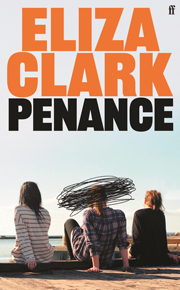 Eliza Clark was named one of Granta’s Best Young British Novelists 2023, on the basis of her 2020 debut novel Doll Parts, a TikTok sensation about a self-destructive bartender who takes explicit photographs of average-looking young men. Her second novel, Penance (Faber), like Pet, explores intricately savage schoolyard politics and conscious self-calibration against social expectations. I consumed it in one long, greedy gulp.
Penance is, above all, an exploration of our voyeuristic fascination with true crime, intensified by online culture (and the podcast legacy of Serial). The crime at its centre is the murder of a 16-year-old schoolgirl, beaten and set on fire by three schoolmates, who were quickly arrested and found guilty to varying degrees. The mystery is not who did it, but why.
The girls’ culpability is eventually extended to encompass (some) neglectful parents and teachers, small-town corruption, untreated trauma and bullying. Culpable, too, is the kind of popular culture that provides an outlet for vengeful feelings, including violent role-playing games and school shooter fandom.
Subscribe for updates
Penance’s prologue presents it as a controversial true-crime book written by a journalist who was accused, post-publication, of misrepresenting interviewees and fabricating content. The conceit? It’s being republished, post-litigation, “in its original form”, with some names changed. So, from the start, we’re invited to question the reliability of both the account and its narrator, who was involved in the UK tabloid phone-hacking scandal.
The story unfolds through excerpts of true-crime podcasts, interviews with family and friends of the victims and perpetrators, and snippets of what we’re told is correspondence with the victims themselves. The reader must piece the story together alongside the unreliable journalist narrator, from the conflicting accounts.
This active construction is mirrored by the characters – particularly the victim, Joan, and the three perpetrators (all misfits to some extent) – who we see consciously creating versions of themselves to fit with how they want to be seen. It’s mirrored, too, in the sensationalised stories told by the seaside town about itself to attract outsiders: from historical stories about persecuting witches to confected ghost stories.
I’m not sure I agree with the novel’s implication that role-playing violence can, as the ringleader of the murderous girls would say, “manifest” it. (Though it’s very much worth thinking about.) But I’m still thinking about Penance’s devastating exploration of adolescent loneliness and despair, its wickedly clever structure, and how it confronts its readers with our own voyeurism and worst impulses.
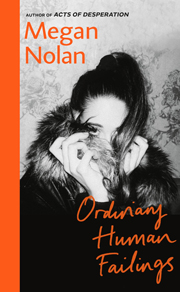 Irish author Megan Nolan visits similar territory in Ordinary Human Failings (Jonathan Cape), another novel exploring the reporting of a terrible crime involving children, framed by the perspective of an unscrupulous male reporter (Tom) – and pieced together through his interviews. However, it dives psychologically deeper, and is tightly focused on the family of the accused perpetrator, rather than ranging far and wide.
Nolan’s purpose seems twofold. The first is to expose the predatory nature of crime reporting, as Clark does. But while Clark raises questions about her unreliable journalist, who addresses the reader and attempts to sell himself to us, Nolan definitively judges hers. Because we’re gifted access to Tom’s inside thoughts that he’s unaware of, we directly observe his hunger for the story and disregard for his subjects. We’re in on his manipulation, rather than being manipulated by him.
“Yes, this is what I have waited for,” he thinks, as he embarks on the story. A toddler, who disappeared while playing with the children on a neighbourhood estate, has been found dead behind some garbage cans, seemingly strangled. The dead toddler is from a good family. The primary-school-aged suspect, Lucy Green, from a notorious “family of Irish degenerates”, is the product of an unwanted teen pregnancy. Since her grandmother died, she’s essentially been “nobody’s child”.
When Lucy is arrested, Tom’s newspaper puts her family up in a hotel, to escape the press pack. His interviews spark flashbacks from each traumatised family member that come together to form a story of how they’ve become so unmoored – and who they once were.
This, too, is a crime story that asks “why?” – but, as its title suggests, the complex answer is one the tabloids wouldn’t bother with. Ordinary Human Failings is a savage takedown of the likes of the sociopathic-seeming Tom and the journalism culture he belongs to. It’s also a beautifully observed, surprisingly moving story about flawed families and generational trauma, with heartbreaking beats of breakdown and connection.
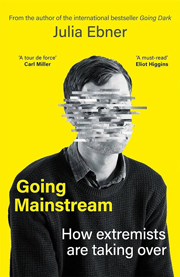 Going Mainstream: How Extremists are Taking Over (Ithaka Press) confronts one of the biggest issues of 2023 and beyond – the post-Trump, post-COVID polarisation of our society. Julia Ebner is a counter-extremism expert whose work involves her going undercover in extremist groups – both in-person and online – and reporting back. Her last book, Going Dark, focused on her undercover work, including an eye-opening day at a neo-Nazi music festival. This book combines these reports with savvy, informed analysis, and presents a fascinating snapshot of the contemporary political divide – with a final chapter exploring strategies for addressing it. The pandemic’s “extra portion of uncertainty, loneliness and other personal challenges” has contributed to deepening the divide, she writes.
Ebner introduces us to the online world of incels, where self-loathing and despair turn to intense misogyny – and misandrists (man-haters), who argue their stance is “a defence mechanism”. We meet left-wing extremists, too, like a key member of Extinction Rebellion who points out “no one approved of the suffragettes” to defend their disruption strategy.
Ebner crashes an anti-climate-change conference under a false name, until she’s discovered and kicked out. She investigates anti-vaxxer communities, revisits a newly powerful QAnon, and devotes a chapter to gender essentialist debates, which she unpacks especially thoughtfully.
She also considers why people are drawn to extremism and conspiracies. “Many people who believe in conspiracy theories feel special because they are ‘the awakened ones’,” one interviewee explains. “They think they are among the few citizens who understand what is actually going on. Your identity can become dependent on that idea.”
Jo Case is a monthly columnist for InReview and deputy editor, books & ideas, at The Conversation. She is an occasional bookseller at Imprints on Hindley Street and former associate publisher of Wakefield Press.
Want to see more stories from InDaily SA in your Google search results?
- Click here to set InDaily SA as a preferred source.
- Tick the box next to "InDaily SA". That's it.
Free to share
This article may be shared online or in print under a Creative Commons licence