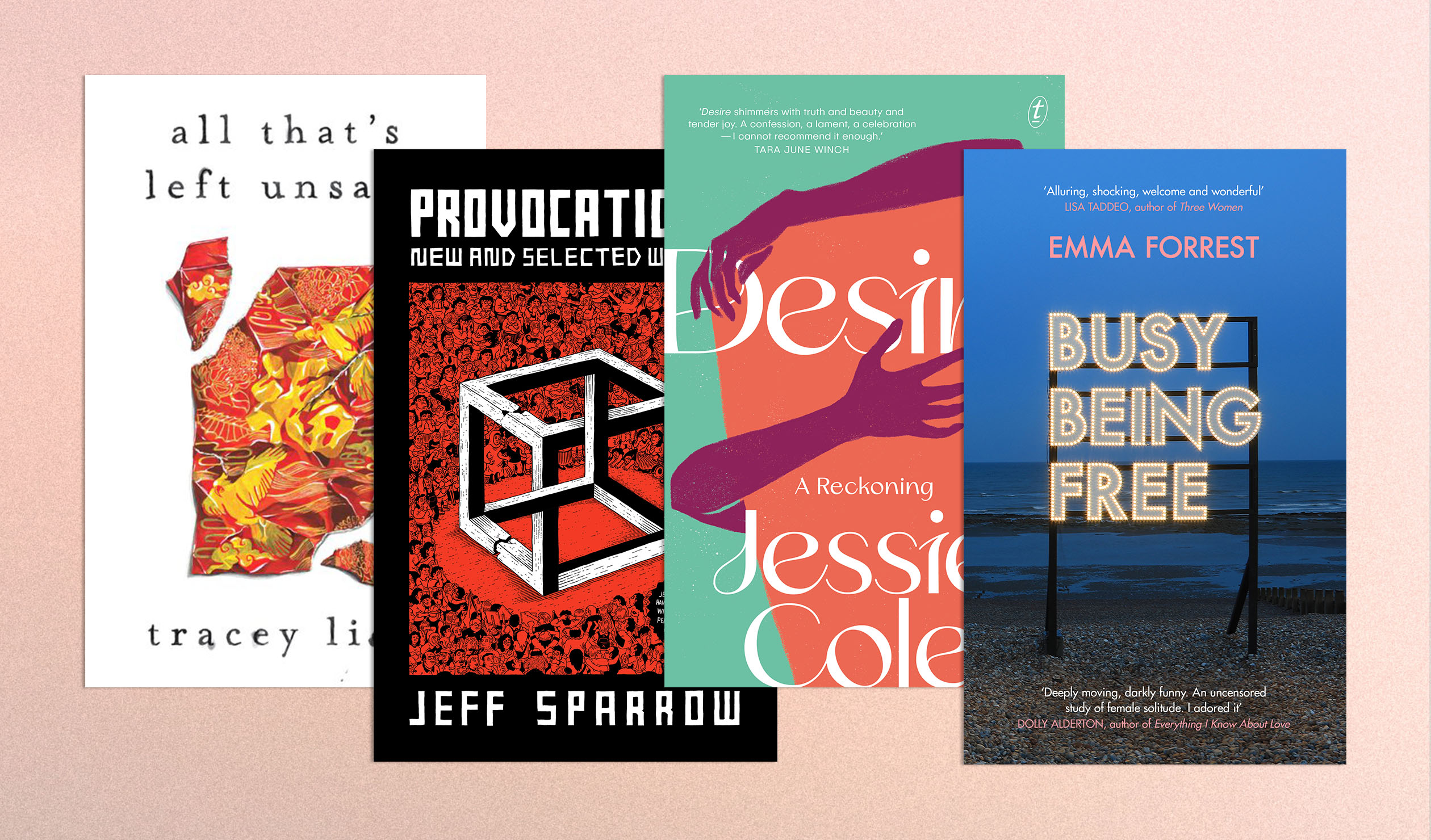
After my divorce from my first husband, there was a period – okay, a few years – when I joked that Ben Mendelsohn would be my second husband. But after reading Busy Being Free, the second memoir of Emma Forrest, who actually married Mendelsohn, I am relieved my real-life second husband is a kind, serene man who only ever raises his voice to warn me not to step into traffic, or tell me dinner is ready.
I greedily consumed anecdotes about Ben crying with happiness the first time Forrest undressed in front of him, befriending a local LA homeless man, and leaving a screening of Once Upon a Time in Hollywood, shouting “Get on with it, Quentin!” at the screen. Shouting: “I’m not shouting. I’m Australian”, during one of many marital spats. Throwing the DVD of a film he hated out of a window, then spitting after it. Honestly, my fantasy crush reads like an insane sweetheart of a man who is a lot of fun to read about, but would be exhausting to be in a relationship with. (I should add here that my crush was NOT on Animal Kingdom Ben, but his character in Love My Way. Which, frankly, I can now see was still problematic, as he seems to have been modelled on Real Ben.)
 But I didn’t read this book for the thrill of Mendo gossip (it’s a bonus), and that’s not why I recommend it. I loved Forrest’s first memoir, Your Voice in my Head, about her mental health struggles and glamourous misadventures as a young woman living in New York and LA, and her productive journey with a great therapist. She writes with lashings of seductive personality, mixing sharp observation, terrific dialogue and black humour with moments of surprising, powerful poignancy.
Busy Being Free, in which she returns with young daughter CJ to the London of her youth after her divorce from Mendelsohn, and discovers who she is again after decades of being defined by men’s desire, is a worthy sequel to that first book. It’s a messy, authentic midlife memoir of self-discovery, reconstituting a relationship with your ex based on co-parenting and the intimacy of really knowing someone, and solo parenting. I found it beautiful, true and charming.
And I just loved reading about Forrest’s relationship with her daughter: going to Kylie Minogue concerts together; filling an inflatable pool for her on the roof of their building, then realising she’d have to somehow drain it (the solution is hilarious and complicated); buying CJ vintage kids’ T-shirts and borrowing them (she dropped her at her first day of Year 1 wearing CJ’s Ralph Wiggum T-shirt).
After her marriage ended (a month after Trump was elected), Emma Forrest – whose adult life had been subsumed in a whirlwind of romantic infatuation – took a vow of celibacy until Trump was no longer president. This helped return her to herself.
You might like

Jessie Cole’s Desire (Text) is also a second memoir. Her first, Staying, excavated and attempted to understand the legacy of two great losses that irrevocably marked her: her older sister’s suicide, when Cole was 12, and her father’s descent into madness and his subsequent suicide, six years later.
 “One suicide lighting the fuse of another, a sort of explosive domino effect,” Cole reflects in Desire, which builds on the first memoir. These ruptures are balanced by powerful anchors: Cole’s rainforest home in the Northern Rivers district of New South Wales, which she has never left; and her close relationship with her mother and two grown sons (who live with her, in the childhood home built by her parents), and a network of female friends.
Cole takes the opposite midlife journey to Emma Forrest: until now, her “primary response to the quandaries of sexual attraction has been to choose celibacy”. On the brink of 40, she embarks on a love affair with an older man from a southern capital city, 20 years her senior. She writes about their encounters as part of a project to understand her complex, fraught relationship with desire. He is reserved, detached; she is passionate, always the instigator. “I’m terrible with women,” he says on their first date. “A confession,” she correctly observes, but convinces herself otherwise, setting the pattern for their four-year relationship of sorts. “I was trying to reanimate my ability to trust,” she says.
Desire is an intricately observed, forensically honest examination of the inherent contradictions and emotional high-wire act of romantic relationships – negotiating different levels of feeling and commitment, weighing ethical obligations and desires. And, perhaps most complex of all, meeting the conflicting needs of two humans, each formed by their own mosaic of life experience.
Cole charts her personal journey with desire – characterised by vulnerability and risk – alongside that of her beloved forest home (symbolising safety and belonging) being beset by the ravages of climate change. Flood, fire, renewal. “How brave I was,” Cole concludes. Indeed she is.
I know “brave” can be a loaded term to describe a memoirist. It can be interpreted as saying the writer has taken a unmodulated leap into the unknown, without considering the potential risk of their disclosures. (If you’re old enough to understand this reference, it’s something like Sir Humphrey’s “how courageous, Prime Minister”, which was public service code for “it’s your funeral”.) But I don’t mean it that way at all. Like most good memoirists – and Cole is an excellent one – her reflections are truly brave, in that they are carefully judged; forensically considered and reconsidered. Shared despite knowing how vulnerable she is making herself. Brave and generous.
Subscribe for updates
Tracey Lien’s debut novel, All That’s Left Unsaid (HQ), set in 1990s Cabramatta, is a stunningly good deep-dive into a family and a community, investigated via a terrible crime. Denny Tran, a perfect student and “good boy”, is viciously murdered in what seems a random attack while celebrating his Year 12 graduation at the kind of Vietnamese restaurant that has a wedding singer even when there’s no wedding. Despite a restaurant full of witnesses, no one saw anything (at least, not officially) – even Denny’s best friend and his English teacher.
 Ky, Denny’s big sister, takes leave from her internship at the Herald Sun in Melbourne to attend the funeral, and finds herself staying to investigate her brother’s murder. No one is talking to the police, so she uses her fledgling journalism skills to access the police notes and a list of witnesses. The novel is haunted by the shadow of Minnie, Ky’s childhood best friend, whose acerbic voice in her head drives her to push harder, to question, to challenge. The question of what happened between Minnie and Ky is a parallel mystery.
The novel is braided with layered detail: about mothers and daughters, about second-generation refugee families in Australia, about intense female friendship, and about racism – both overt and implicit. For instance, this sliver is both specific and rich with universal truth: “Ky didn’t allow her mother to have feelings, because to grant her these would mean acknowledging that she was a person who had desires and dreams beyond what Ky saw. It was easier to imagine her as a caricature, as an immigrant Cabramatta parent.”
It’s a terrific, heartbreaking set-up, and would work as a cracking crime novel. But it’s so much more than its mystery plot. This may sound like an odd comparison, but All That’s Left Unsaid reminds me of the great crime television series The Wire, in that like that show, the crime is a way in, a vehicle for exploring the intricacies and injustices of a community, shaped by wider societal problems and made unique by the nuanced humans who live in it. I felt invited into Tracey Lien’s Cabramatta the same way I was to David Simon’s Baltimore. (A comparison that includes the inevitable fascination, discomfort and education of being a tourist in another culture.)
And as in Simon’s work, the law is not a comforting repository of trust. “She’d expected – in hindsight, unrealistically – that the entire local police force would be dedicated to righting the injustice that had been committed against her brother, that there would be some form of acknowledgment of how deeply disturbing it was that Denny, of all people, could be murdered. Instead, she’d never felt more invisible; her brother, alive only a week ago, had already been forgotten.”
It’s because the law doesn’t work as it should, because the death of Denny – a model immigrant – is somehow not a priority, that Ky takes matters into her own hands. The journalist as investigator is a common narrative (one I love). But when journalists are tasked with uncovering crime in the place of a detective, it’s because the system has failed. Think All the President’s Men, perhaps the most famous of the genre.
 Finally, I’d like to give a little shout-out to a new book by one of my favourite writers and thinkers – someone I love to read for the way he questions orthodoxies, including his own. Provocations (New South) brings together some of Jeff Sparrow’s best work over the past 20 years. It opens with a magnificent long essay on the indentured labour of Pacific Islanders (some coming voluntarily, but misled about conditions, others outright kidnapped) on Queensland’s cane fields, which was so widespread that some called Queensland a “slave state”.
The essay puts in the context of American slavery, and British abolition – and teases out the complexities, including the racism of many abolitionists. But it also ranges widely across topics as diverse as thylacines, socialism and cycling, gun massacres in the US (which were largely unknown before 1966). and the anti-politics of Anzac Day.
Father’s Day is coming up, and my dad, if he reads this column, will discover that Jeff’s book is what he’s getting for the occasion.
Jo Case is a bookseller at Imprints on Hindley Street and deputy editor, books & ideas, at The Conversation. She is a former associate publisher of Wakefield Press.
Want to see more stories from InDaily SA in your Google search results?
- Click here to set InDaily SA as a preferred source.
- Tick the box next to "InDaily SA". That's it.
Free to share
This article may be shared online or in print under a Creative Commons licence