Book review: Girt Nation
David Hunt’s latest fascinating romp through our past shows Australians to be more eclectic and eccentric than we might have imagined.
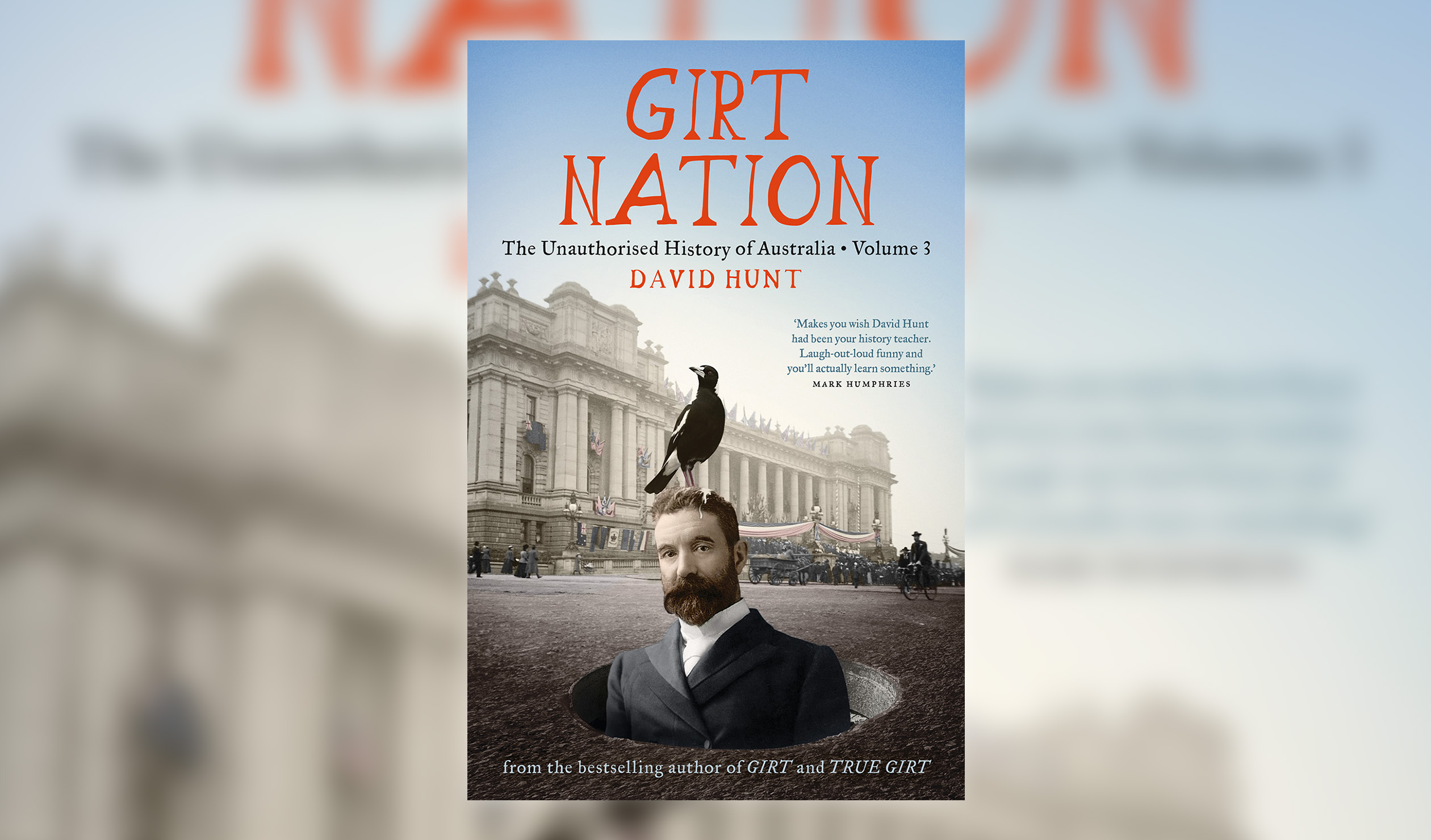
Girt Nation is the third volume of David Hunt’s wonderfully insightful and irreverent “unauthorised history of Australia”, following on from Girt and True Girt. Like its predecessors, it retells our national story with humour and genuine affection. It is indeed “an epic tale of charlatans and costermongers, of bush bards and bushier beards, of workers and women who weren’t going to take it anymore”.
Hunt’s key player this time is Alfred Deakin, three-term prime minister and leading light of the Spiritualism movement in Australia. “Affable Alf” was considered to be a skilled medium and claimed to take counsel from those in the spirit world. He was an impressive parliamentary performer and a campaigner for a range of causes that would be popular today, including animal rights and women’s rights.
Deakin was also, however, instrumental in passing the White Australia policy through parliament during Edmund Barton’s term as Australia’s first prime minister. Hunt describes the politician as “nuanced in his xenophobia”, with Deakin’s views on immigration coming from his belief that “unity of race is an absolute essential to the unity of Australia”. And while he was generally conservative in his political views and his relationship with the British Empire, he notably refused a knighthood.

From here, Hunt traverses this wide brown land geographically, politically, and culturally. Many well-known people are revealed in a more full and frank way than in other, more conservative accounts.
Catherine Helen Spence, an early feminist and social critic who is widely acknowledged for her work on children’s rights and progressive childcare, was also a campaigner for tighter immigration restrictions. She was especially concerned that the Chinese people wanted to come to Australia “to destroy all we have struggled for!” And what of the social and religious influence of Muscular Christianity on the young nation of Australia? (Yes, it’s a thing.)
You might like
After 18 months of living with COVID, it’s fascinating to look back to 1900 and the outbreak of bubonic plague in Australia. In an effort to curb the spread, children in Sydney were offered sixpence for each dead rat they collected and handed in to the authorities, a gruesome precursor of today’s 10-cents-a-tin recycling incentive.
A quick glance at the Girt Nation index gives an indication of the rollicking read in store. Most books of political history don’t include a lengthy list of entries under the heading “weird shit”, nor do they devote equal space to “alcohol” and “art” – actually, art wins in this case. The astonishing thing is that these stories are true and are brought to life with Hunt’s colourful storytelling.
Like all the most effective works of humour and art, Hunt’s writing becomes a mirror in which we see ourselves reflected a little more vividly. The Australians we see are more eclectic, more interesting, and a little more eccentric than we might have imagined. They are full of life and passion and a touch of madness and more than a hint of badness.
Girt Nation celebrates these differences, extols their virtues and acknowledges their follies, and helps us understand how we came to be. As the popular song says “I am, you are, we are Australian” – whatever that means.
Girt Nation, by David Hunt, is published by Black Inc. Hunt – “an unusually tall and handsome man who likes writing his own biographical notes” – is the author of previous books Girt and True Girt, and also a television presenter and podcaster.
Want to see more stories from InDaily SA in your Google search results?
- Click here to set InDaily SA as a preferred source.
- Tick the box next to "InDaily SA". That's it.
Free to share
This article may be shared online or in print under a Creative Commons licence