Book review: Throat
This review in Writers SA’s literary criticism series A Year in Review looks at Ellen van Neerven’s irreverent poetry collection Throat, a work that reaches ‘beyond the confines of the white imagination’.
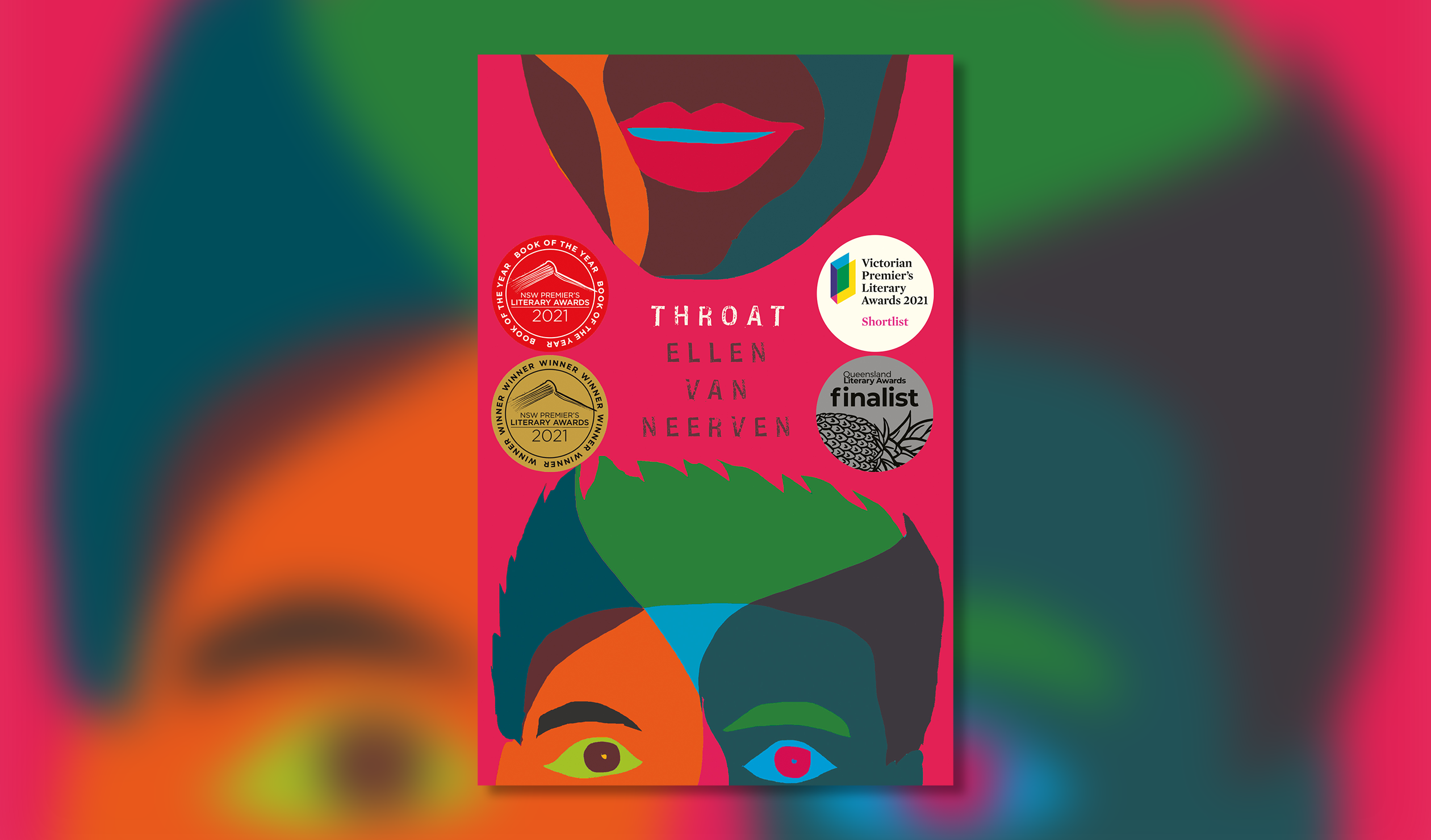
Throat – Mununjali Yugambeh author Ellen van Neerven’s second collection of original poetry – speaks for itself, in conversation with a range of other texts.
Opening with an epigraph from Patience Agbabi (“no one’s found / until they find themselves hurting / in the back of the throat”), it is welcoming (“take me to the back of yr throat / I’ll stay”) in the same breath that it resists being pulled apart and examined (“how do we co-exist on this page?”)
Throat challenges the “centre of whiteness”, described elsewhere by Wiradjuri writer and academic Jeanine Leane; the poems deftly side-step any categorisation within “the margins of otherness it [whiteness] defines”.
When I think of the throat I think of stretching my chin up to the sky, not to look up but to feel how it might be to not have cut-out edges, to be “boundless” like the projections of the “‘white imagination’” outlined in Leane’s essay. By surpassing the bounds of the “settler imagination” Throat reminds us: “we’re all sleeping on a sensation / bigger than us, bigger than the body”.
The words move on and off the page, stretching up, down and across (see “Portrait of Destiny”, which is comprised of quotes from Destiny Deacon’s 1996 artist talk), with some uncontained by titles (“whiteness is always approaching / guilt makes people interesting / I found out Indigenous Studies has nothing to do with me”).
Even the five sub-headings of the book (‘they haunt walk-in’, ‘Whiteness is always approaching’, ‘I can’t wait to meet my future genders’, ‘speaking outside’ and ‘take me to the back of my throat’) resist being contained by what they cover and how they cover it. They flow over and into each other, grounded in the personal and domestic; from “Vinegar” to a page of “unsent txt messages” to “homoe (n.homosexual domesticity / at home with your homo)”.
You might like

In her review for the Sydney Review of Books, Leane mentions the throat being connected to sensing organs. The heart, connected to the sense organs through the throat, is one of many body parts in the collection alluding to the fluidity of the body (“we’ll remember / my heart as a t-shirt / ripping under the arms” and “the sheets are cold / her heartbeat’s running like a fridge”).
The poem “Chermy” walks us through a gentrifying landscape, simultaneously unearthing climate destruction (“aliens will arrive / in what’s left of the forest”), connections to place (“I will show my new alien-lover Westfield Chermside / tell her that it is sacred and must not be harmed”), family and being First Nations and queer on invaded land:
I will show my new alien lover and she will understand / my love for Chermy / you haven’t lived life on earth until you’ve been to Harris Scarfe / and seen their price on bras! / the brand Serena Williams likes / and met my family / my fam are pretty deadly /.
Throat’s astute humour is doubly effective in turning the “coat of oppression” inside out and revealing the lining. The poem “White Excellence (after Thelma Plum’s ‘Woke Blokes’ and Aunty Kerry Reed-Gilbert’s ‘Visitors’)” chuckles across the page in two blocks of text, opening with “When it comes to having white people in my life, I choose the cream of the crop …” and finishing on “White Excellence makes good guests because they know they are permanent Visitors”.
“The Only Blak Queer in the World” is vivid with references, even when marking absence in the first half (“I hadn’t seen Electric Fields perform in a sweaty old meat market with a group of friends who had similar feelings”), pooling at “I saw the white gays and the white gaze I was used to and then I saw Blak Queers everywhere”, before the lines brim with voices (“I read Natalie Harkin’s, Yvette Holt’s, Nayuka Gorrie’s and Alison Whittaker’s writing”).
The three and a bit pages of notes at the end unfold the collection even further. Capillaries branch off throughout, with poems like “logonliveon” and “Body Flow” interacting with other artwork from the “margins” which, as noted by Leane in her essay, “are locales of agency” and can “decentralise and speak up to the centre”.
Subscribe for updates
Van Neervan’s collection notes the “poetic dissonance” in isolating women’s rights from Indigenous rights, asking “and our womxn? / I’ve been looking for you / I find you in the absence / I go back home”. The inextricability of ecocide and colonisation also emerges:
While the ship sails in southern seas
the ship-shaped hole
thousands of years deep
aches and aches.
Throat is as deeply self-reflexive as it is intertextual, collapsing the edges of fixed identities:
. . .my skull
size was commissioned, my heartlines were commissioned.
this was a commission too.
“An infinity of words can lovingly dream the world anew,” writes Natalie Harkin in her book Dirty Words. Throat does this, reaching beyond the page (“that script they try and write us in will no longer contain us”), and beyond the confines of the white imagination (“telling us who we are / not who we aren’t / defying a fixed identity”).
Throat, by Ellen van Neerven, is published by UQP.
Anisha Pillarisetty is a journalist at On the Record and a presenter and producer at Radio Adelaide, living on unceded Kaurna Country. Her poetry will be published in The Saltbush Review and More than Melanin later this year.
———-
A Year in Review is an initiative by Writers SA, with assistance from the Australia Council of the Arts, to produce a series of book reviews published in InDaily over 12 months.
The reviews will focus on titles published during the pandemic, highlighting the work of Australian authors and publishers during this difficult time for the sector, and giving literary critics an outlet for their work that supports a strong culture of reading.
See previously published reviews here.
Want to see more stories from InDaily SA in your Google search results?
- Click here to set InDaily SA as a preferred source.
- Tick the box next to "InDaily SA". That's it.
Free to share
This article may be shared online or in print under a Creative Commons licence