Diary of a Bookseller: Spotlight on South Australian authors
Dystopian adventures, debt-trap misadventures, invisible illness, stories of quiet rebellion and a rollicking boyhood memoir … bookseller Jo Case surveys the strong crop of new books by South Australian writers.
September 2020 has been a HUGE month for new-release books. The UK Guardian reported that more than 600 books would be published on one day, September 3, due to the many books delayed for publication because of COVID-19. Australia hasn’t faced quite such a deluge, but it’s been… a lot.
We’ve had a spread of terrific books by South Australian authors this month, too.
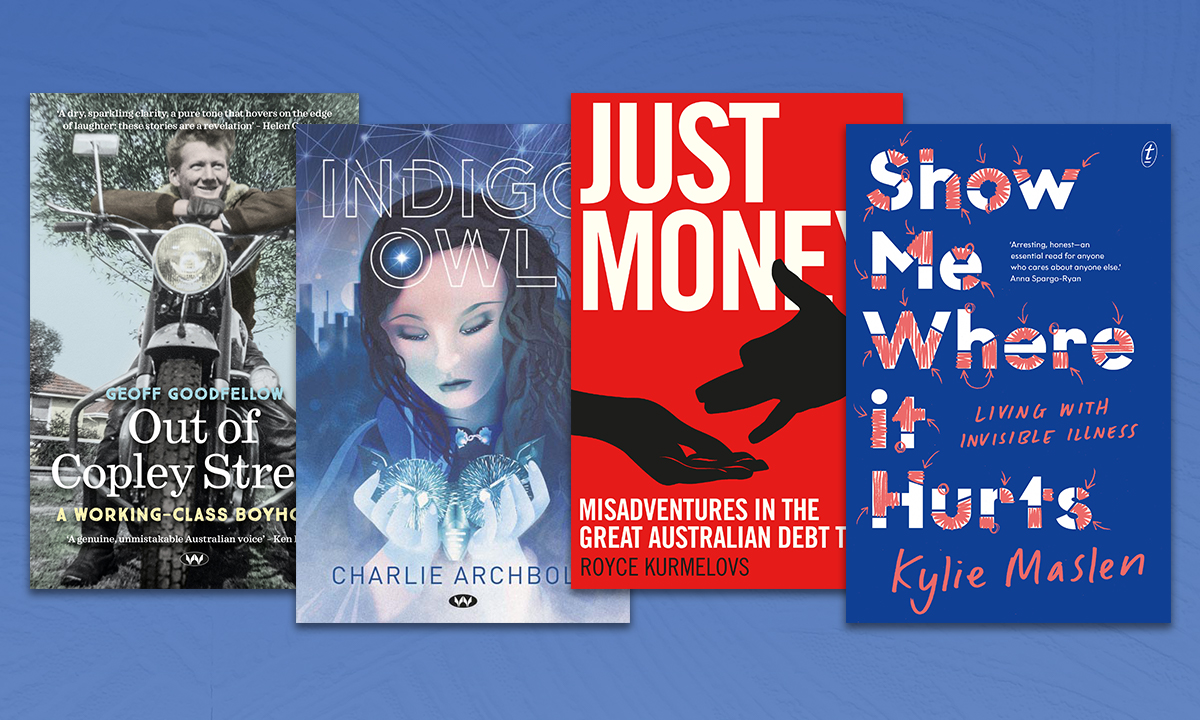
There’s fast-paced space dystopia Indigo Owl, the second YA novel by Charlie Archbold, who was awarded an Honour Book in the Children’s Book Council of Australia Awards for her debut, Mallee Boys, in 2018. With a fertility-control conspiracy to crack, three vibrant young teen characters determined to change their world, and both psychic abilities and a tech whiz in its arsenal, it’s hugely appealing.
 Katerina Bryant’s Hysteria: A Memoir of Illness, Strength and Women’s Stories Throughout History (New South) is a beautifully written reflection on Bryant’s frightening experience of the onset of recurring dissociative episodes – what would once have been termed hysteria – that is in conversation with the history of so-called “hysterical” women and a medical system that has long dismissed or under-estimated women’s invisible illness. It’s personal, political and deeply intelligent.
In one of those strange publishing coincidences, another Adelaide writer, Kylie Maslen, also published a book this September on being a woman living with invisible illness: Show Me Where It Hurts (Text).
These books are less competitors than complementary reads, with plenty of overlap (and sharing endorsements from Fiona Wright and Anna Spargo Ryan) but also very different ways of exploring the subject. Anyone interested in this subject really should read both.
You might like

“To be a woman in pain is to be vulnerable in a society that erases us even when we are well. So we keep our pain and ourselves hidden,” writes Maslen. “No one ever said it was all in my head, but they came close.”
These two books work together to reverse that erasure.
 Show Me Where It Hurts is an immediately immersive personal essay collection that explores the experience of chronic pain (endometriosis, polycystic ovary syndrome, chronic pelvic pain) and mental health issues (including a late bipolar diagnosis) through engagement with pop culture: music, art, literature, film, TV and online culture.
Maslen also writes about how her illnesses affect her life on an everyday level, from work and dating to friendships and family, and future planning. She considers questions like how we can represent pain or disability without fetishising it, and is painfully honest about how she self-medicated using alcohol and drugs in the absence of adequate pain relief from her doctors.
But this book is passionate and intermittently joyful, too, in its deep dives into pleasures like Beyonce, Crazy Ex-Girlfriend, BoJack Horseman, and Spongebob Squarepants. And there’s an absolutely brilliant essay on the appropriation of Frida Kahlo as “inspiration porn” and the diluting of her fierce politics, including an unforgettable image of UK conservative leader Theresa May spotted wearing a bracelet with the face of Kahlo, “a woman who … LITERALLY DATED TROTSKY”.
 Adelaide journalist Royce Kurmelovs delivers an outstanding work of reportage in Just Money: Misadventures in the Great Australian Debt Trap (UQP). Kurmelovs is drawn to his subject after a car crash just off Port Road (and no insurance) lands him with a debt of more than $20,000, and a series of encounters with debt collectors.
Subscribe for updates
“It felt like an invisible hand had reached down from the sky to press into my chest,” he writes of receiving the calculated amount of his debt. “It felt crushing.”
Kurmelovs uses his emotional reaction as a springboard to research debt in Australia, from a macro-level exploration of the history of loans, bankruptcy and the effects of neoliberalism, our banking system and the contemporary housing market, to profiling Australians who’ve found themselves mired in debt for various reasons. And, perhaps best of all, there’s an in-depth look at Australia’s Centrelink robodebt fiasco: how it unravelled, who it affected, what the consequences were, and how collective action actually resulted in system reform.
I kept regaling people I know (especially my poor husband Luke, who I followed around spouting facts as he made dinner one night) with facts or anecdotes from this book. “I’m now convinced that Pauline Hanson was elected on her stance against the banks as much as racism,” was one idea that got us talking.
Just Money is an illuminating and absorbing book that will appeal to readers who enjoy Michael (The Big Short) Lewis’s books – like Lewis so often does, Kurmelovs tells a big-picture story about the failings of our system through a combination of facts, human stories and intelligent, accessible analysis.
 Finally, Adelaide literary icon Geoff Goodfellow, known for his electrifying spoken-word poetry performances on building sites, jails and in schools (as well as at the usual literary festivals) has released his first prose book, a memoir of his inner-north Adelaide childhood in the 1950s and ’60s, Out of Copley Street: A Working-Class Boyhood (Wakefield Press), glowingly endorsed by Helen Garner and Tim Winton, who calls it “a rollicking slice of an unlikely life”.
I confess, in the name of declaring my sizable interests, that in my day job at Wakefield Press, I edited Out of Copley Street (and I did a second edit of Charlie Archbold’s YA novel, too), but a round-up of SA books published in September just isn’t complete without it.
And while I’m being cheeky (and comprehensive!), I must make a quick final mention of another Wakefield Press book (also edited by me) written by a South Australia-born writer, with several stories set in Adelaide. Emma Ashmere’s exquisite short-story collection Dreams They Forgot explores the hidden or sidelined lives of quiet (mostly women) rebels, and includes a haunting story set in Adelaide’s Destitute Asylum in the 19th century, shortlisted for the Commonwealth Short Story Prize.
Jo Case is a bookseller at Imprints Bookseller on Hindley Street and an associate publisher at Wakefield Press.
Royce Kurmelovs will be in conversation with Imprints’ own Ben Brooker on Zoom, on Wednesday, October 7, at 6.30pm (Adelaide time). The event is free, but please register.
Show Me Where It Hurts author Kylie Maslen recently spoke with CityMag about her book and the physical and mental effects of living with an invisible illness. Next week on InDaily, reviewer Heather Taylor Johnson will share her thoughts on Katerina Bryant’s Hysteria and its particular resonance in the time of COVID.
Author and poet Geoff Goodfellow recently shared the story of his journey from working-class lad to literary icon as part of SALIFE’s My South Australian Life first-person series.
Want to see more stories from InDaily SA in your Google search results?
- Click here to set InDaily SA as a preferred source.
- Tick the box next to "InDaily SA". That's it.
Free to share
This article may be shared online or in print under a Creative Commons licence