Film review: The Assistant
Australian director Kitty Green takes us through a day in the life of a movie mogul’s assistant in a tense exposé of film industry power dynamics as seen from the bottom rung.
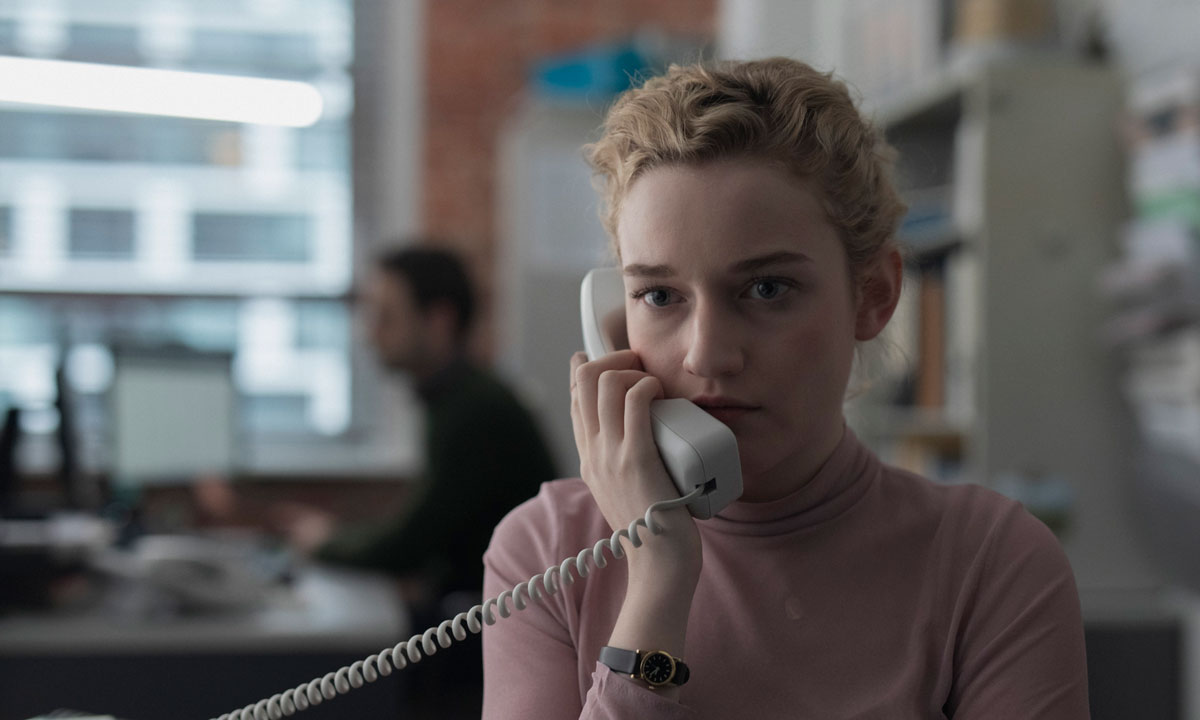
This is not a new story. Over the last few years, the Harvey Weinstein scandal and the #MeToo movement have opened our eyes to the misogynistic and predatory behaviour rampant in the film industry. But Kitty Green tackles this subject with subtlety, insight and a distinctively non-Hollywood flavour, keeping viewers on edge and hyper-aware of the power dynamic pervading every moment of the film.
This is a movie in which all that is left unspoken and unseen speaks louder than the dialogue.
The film follows Jane (Ozark’s Julia Garner) through her day working as the lowest-ranked assistant of an unnamed, unseen film industry mogul, clearly based on Weinstein.


The film opens in the pre-dawn darkness outside her Queens apartment, where a town-car waits to drive her in to the office. She’s the first to arrive and the film follows her through her monotonous and far-from-glamorous daily tasks: making coffee, photocopying, compiling scripts, printing schedules and, more distressingly, disinfecting her employer’s couch.
As her colleagues arrive, the office hierarchy and workplace gender dynamics are gradually revealed. At the top is the unseen boss, whose presence has the entire staff on tenterhooks. His assistants are on constant alert to satisfy his every demand. What’s going on behind the boss’s closed door is common knowledge, but no one dares to speak up, aware they are all instantly replaceable.
Conscious of her low rank in this combustible work environment which she shares with two other patronising and disrespectful male assistants, Jane strives for invisibility. This survival tactic of not drawing the slightest adverse attention puts the responsibility on audiences to read between the lines of Jane’s mounting fear and discomfort.
When an extremely young and pretty new assistant (Kristine Froseth) is flown in from Idaho, Jane finally decides to speak up about the office’s open secret – that the man she works for is using the power of his position for sex. Unfortunately, she lacks both solid evidence and anyone willing to either listen or act.
Subscribe for updates
Garner plays Jane with exquisite subtlety, allowing Green to masterfully sustain an atmosphere of simmering fear and tension that permeates the entire office. Green, using skills honed in her previous documentary work (Casting JonBenet and Ukraine is Not a Brothel), based her screenplay on interviews with assistants in the industry and describes the film as “a composite of the thousands of stories I’d heard, seen through the eyes of one woman”.
The cinematography powerfully reinforces Jane’s sense of isolation and powerlessness, while the cold, pale colour palette, fluorescent lighting and tight, stark shots lend the film a claustrophobic air.
Green’s exploration of this subject may seem restrained when compared with other Hollywood depictions such as Bombshell. But The Assistant takes a different approach. Instead of focussing on high-profile whistle-blowers, this bottom-up perspective exposes the institutionalised disempowerment of women working in entry-level positions and the toxic workplace dynamics that passively enable abuse.
The Assistant is available to rent now via Foxtel on Demand, and will also be available from June 24 on multiple other VOD platforms including Google Play, iTunes, Fetch TV and Telstra Bigpond.
Want to see more stories from InDaily SA in your Google search results?
- Click here to set InDaily SA as a preferred source.
- Tick the box next to "InDaily SA". That's it.
Free to share
This article may be shared online or in print under a Creative Commons licence