Art installation imagines life billions of years ago
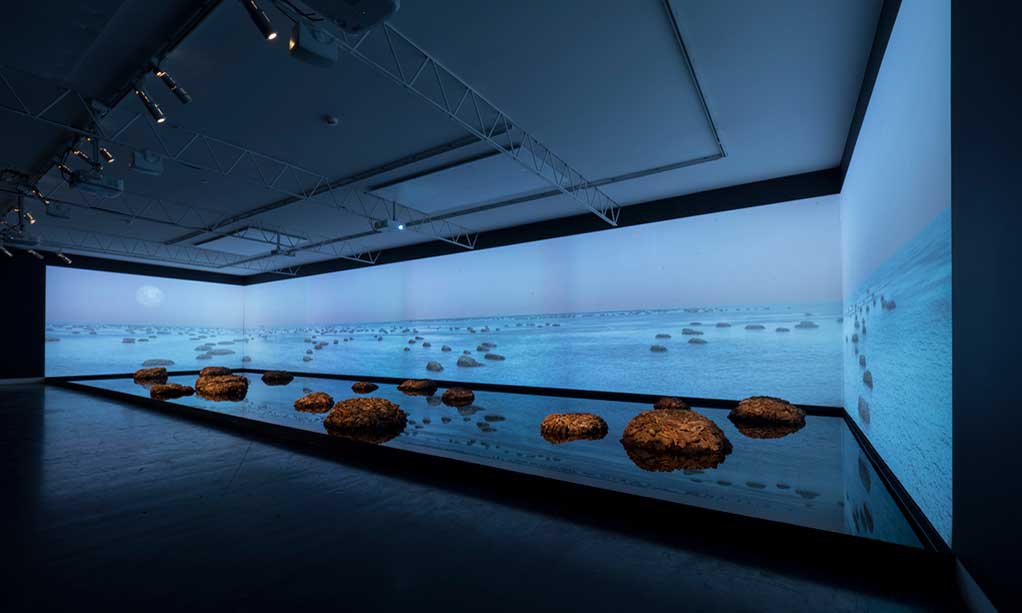
South Australian artists James Darling and Lesley Forwood are transporting people back three billion years with a new exhibition at Hugo Michell Gallery that imagines what the Earth was like when life was only just beginning.
“The sense of imagination, as Einstein said, is more important than knowledge,” says Darling, who this week opened his collaborative exhibition Living Rocks: A Fragment of the Universe with fellow artist Lesley Forwood.
“Here, we are trying to make meaning from what is existing to what was the beginning of life on Earth at least three billion years ago.”
The expansive installation floods two-thirds of the 17m-long gallery space in around 30cm of water.
Scattered in the water pool are re-creations of thrombolites – rock-like accretions of biota that photosynthesise when exposed out of water. Darling and Forwood’s re-creation of the ancient organisms are made from Mallee root – a signature material in their sculptural work.
“This is based on Lake Hawdon in the upper-south-east, between Beachport and Robe. There, I found thrombolites,” Darling says.
“An ecologist told me that I should go see these things. I’m a farmer – I live in the south-east – so Lesley and I walked into this lake and we were just utterly blown away by this otherworldly, ethereal landscape as it were; no beginning and no end.
“Since that absolutely extraordinary experience, we knew we wanted to do this.”
You might like

Darling is hesitant to reveal the exact location of the thrombolites, which have existed at Lake Hawdon for billions of years.
“My fear is that more people will understand what an extraordinary place it is and put it under threat,” he says.
“We did have a genuine conversation about whether we wouldn’t use the proper name because of that fear. But it is pretty hard to find – you do have to know how to get there and you wouldn’t be able to get there with a two-wheeled vehicle, for example.”
The work is a conceptual and imaginative piece of art, inspired by scientific knowledge of what the Earth looked like billions of years ago.
Darling and Forwood consulted with “two of the most prominent professors in their field” – Professor Malcolm Walter from the University of New South Wales and Professor Robert (Bob) Burne from Australian National University – to better understand how the Earth’s landscape evolved.
“Bob Burne called microbialites ‘the default ecosystem’ of the planet,” Darling says.
“We now have landmasses and the Earth has changed, but the sense is that microbial life might be the only lifeform that survives.”
Eclipsing the water pool is a virtual-reality projection, which screens a 20-minute loop of constantly changing scenery inspired by an imagination of what Earth looked like billions of years ago.
Subscribe for updates
It was created in collaboration with Adelaide-based virtual effects company Jumpgate VR.
Jumpgate stated out doing animations for engineers and government, as well as training work for mining companies and AFL teams, but in recent years has also undertaken projects in the arts world. It was involved in making the short film The Summation of Force, by Trent Parke and Narelle Autio, which premiered at the Adelaide Film Festival last year and screened at this year’s Sundance Film Festival.
VFX supervisor Edward Watson says that to make the imagery for Living Rocks as real as possible, the company travelled with Darling to Lake Hawdon to take photogrammetry scans of the thrombolites.
“As far as capturing real elements and trying to display them as close to accurate as possible, it’s something we do fairly regularly,” Watson says.
“As far as re-creating three billion years ago, that’s something we’ve never done before until now.”
Darling and Forwood also collaborated with Australian String Quartet for the exhibition’s background music.
“They have a new piece that they’ve just recorded by a New South Wales composer called Paul Stanhope at Ukaria in the Adelaide Hills,” Darling says.
“The music has an otherworldly universality that is strangely fitting.”
Darling says the exhibition is ultimately about celebrating microbial life.
“It’s a memory of our origin and a prophesy of our future because there have been great extinctions in the whole history of the world and the one life form that has survived every great extinction are microbialites, and they’re likely to survive the next great extinction too.”
Living Rocks: A Fragment of the Universe is showing at the Hugo Michell Gallery in Beulah Park until July 14.
Want to see more stories from InDaily SA in your Google search results?
- Click here to set InDaily SA as a preferred source.
- Tick the box next to "InDaily SA". That's it.
Free to share
This article may be shared online or in print under a Creative Commons licence