Upon leaving the Festival Centre and running into a slew of friends (as you do during Festival season), I heard reverberations of “I don’t know what it was about but I loved it”.
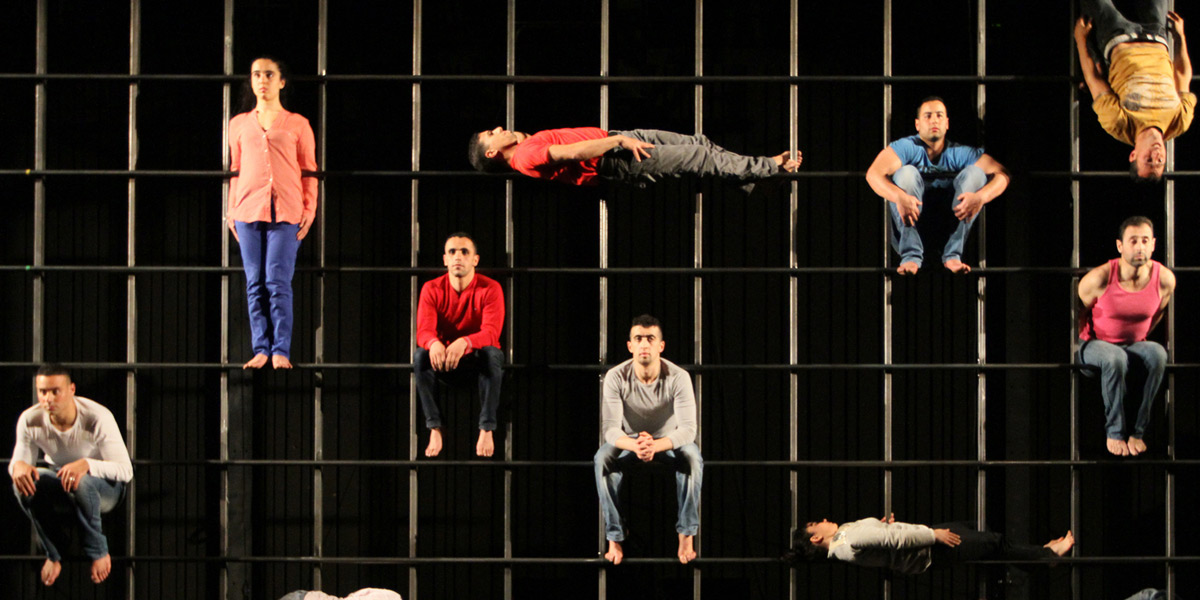
How is that okay for something of Festival calibre? Let’s see if we can work this out. Azimut might be defined as such: an Arabic word for the angular measurement in a spherical coordinate system. Not sure if that helps, but if you place yourself in a chair in front of a stage that showcases a squared fence-like structure where performers climb up and down and upside down under omniscient and perfect lighting, then you might be able to see the symmetry and the artistry of the exercise and you might just find that this is one of the finest experiences in lighting and theatre that’s come your way in a long time and, in my case, ever.
I do believe I might have been witness to a production that was thematically based upon human dependency, and the need for it, the drive toward it, and the inescapable connectedness of it. But I might be wrong.


Pretty much the cerebral part of my brain was overtaken by the aesthetic part in the same way that it was when I first saw Pink Floyd’s The Wall. I was too naïve, at 14, to completely understand what it was all about but I was old enough to know that it was the most spectacular vision my TV had ever projected. The meaning eventually came to me, but only through visual overload.
As with The Wall, I let the visuals of Azimut wash over me, and it wasn’t as relaxing as it might sound. I was basically on the edge of my seat, trying to comprehend what was going on in front of me without losing the purely visual art that was taking place only metres away. The acrobatics are to be applauded, but I have to say that it is the lighting that makes the show the remarkable force that it is. At times there is a fade-in/fade-out; at others there are optical illusions.
My favourite scene looked as if it was shot on a grainy film from the ’70s and another seemed in fast motion, a fit of lighting effects moving time and melting space. Sometimes the lighting comes from the ground so that there is a dream-like quality taking place, sometimes from a flashlight held by one of the acrobats so that the audience is held accountable.
There are hulking shadows, like in fairytales, and sharp shadows with bright lights, like in a ’60s pop art installation. People emerge like ghosts. There is confusion, danger, monotony and hope.
Subscribe for updates
If you missed the show during the Adelaide Festival, do pay attention to Aurélien Bory and Le Groupe Acrobatique de Tanger. Their production is truly visual, truly magnificent. I’m sold.
Azimut was presented the Festival Theatre as part of the 2015 Adelaide Festival.
Click here for more 2015 Adelaide Festival stories and reviews.
Want to see more stories from InDaily SA in your Google search results?
- Click here to set InDaily SA as a preferred source.
- Tick the box next to "InDaily SA". That's it.
Free to share
This article may be shared online or in print under a Creative Commons licence